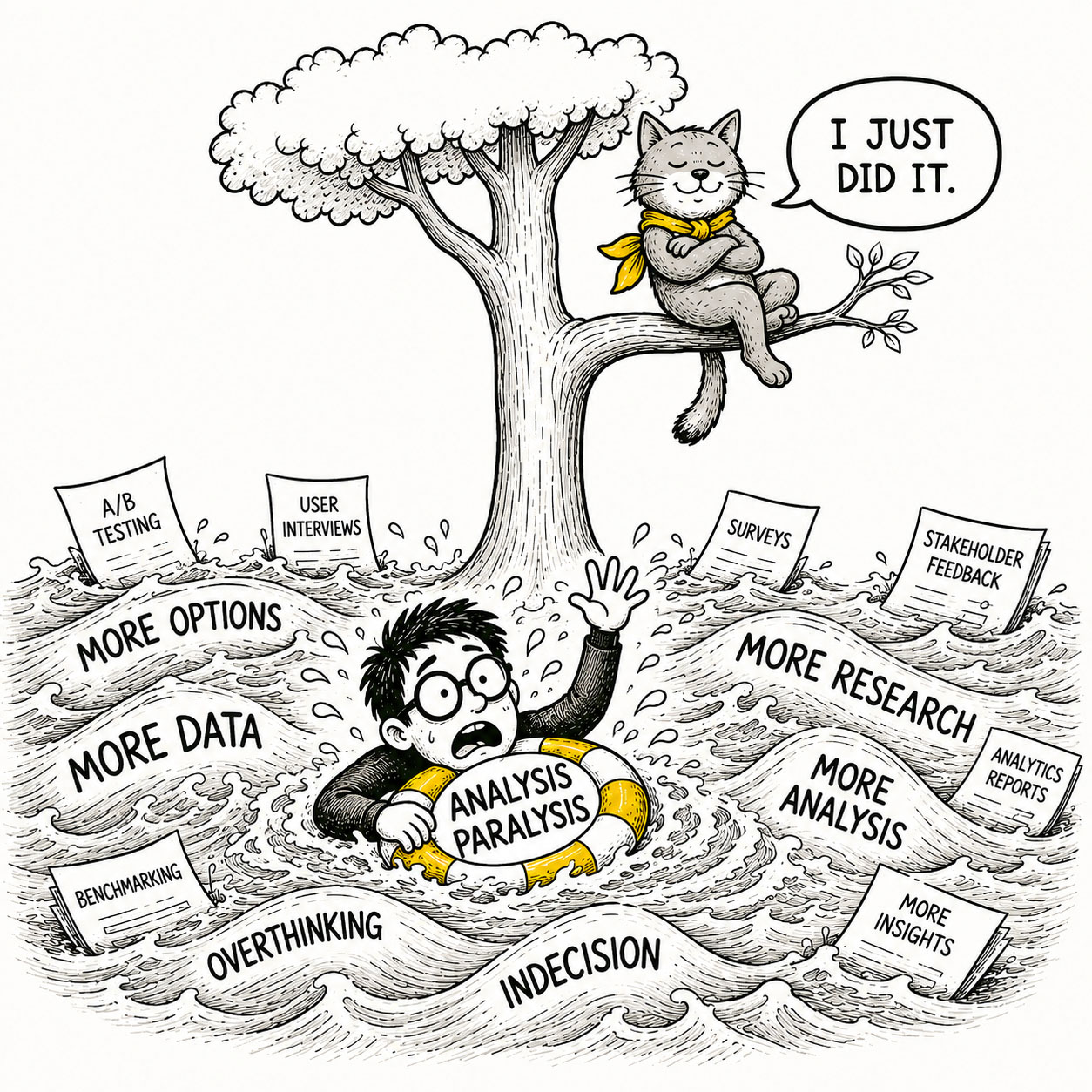
Analysis Paralysis is what happens when the pursuit of the best decision prevents any decision at all. Faced with too many options, too much information, or too many possible outcomes, thinking begins to replace action. What starts as careful consideration slowly turns into hesitation, as each new piece of data introduces additional complexity rather than clarity. The intent is to make a better choice – but the result is often no choice at all.
In UX and product design, the dynamic is the same. More options, more data, and more possibilities promise better decisions – but without focus, they often lead to hesitation instead.
ORIGIN
The idea behind Analysis Paralysis has been around long before it had a name. One of its earliest expressions appears in the ancient fable The Fox and the Cat, often attributed to Aesop. In the story, the fox proudly claims to know hundreds of ways to escape danger, while the cat admits to having only one. When a pack of hounds approaches, the cat quickly climbs a tree and reaches safety. The fox, still evaluating options, gets caught. The moral is simple: Better one safe way than a hundred you cannot decide between.
The fable captures the essence of Analysis Paralysis long before modern psychology did. When faced with too many choices, the ability to act breaks down. What should increase your chances instead becomes the very thing that prevents you from moving at all.
WHEN
Analysis Paralysis occurs more often than you’d think (or wish for). The following are some commonly seen situations:
- Research keeps expanding
“There’s just one more thing we should validate.”
- Decisions are constantly deferred
“Let’s look at a few more options first.”
- Too many options exist
Users are overwhelmed with the amount of options to choose from.
- Stakeholders seek perfect alignment
Everyone needs to agree before anything moves forward.
- You hear: “We need more data”
Even when (albeit imperfect) data already exists.
If progress slows as understanding grows, you’re likely already paralyzed.
WHY
Analysis Paralysis is driven by good intentions but certain human traits still prevent us from moving on. The following reasons describes why you may be stuck:
- Fear of making the wrong decision
It feels safer to wait than to commit.
- Overvaluation of data
More information is assumed to lead to better outcomes.
- Too many possibilities
Choice increases complexity.
- Desire for certainty
Teams want confidence before acting.
- Low cost of thinking
Analyzing feels productive, even when it isn’t.
The result is a system optimized for avoiding mistakes, but not for making progress.
HOW
It’s actually not difficult to avoid analysis paralysis. I’m not telling you to think less, rather solve it through better decision-making. Here are some key tips to prevent paralysis:
- Define what “enough” or “done” looks like
Know when you have sufficient information to act.
- Timebox decisions
Endless analysis expands to fill available (or not yet available) time.
- Reduce options intentionally
Work hard to reduce choices which will lead to clearer decisions.
- Separate learning from deciding
Research informs decisions – it shouldn’t replace them.
- Accept imperfect decisions
Many decisions can be adjusted later, acknowledge the trade-offs, icebox decisions, and come back to them later. Sometimes you’ll find that something else has superseded them.
PRO TIP
Great teams don’t wait for 100% certainty to move on. They make informed decisions and progress with confidence.
EXAMPLES
- A redesign delayed for months due to ongoing research
- Multiple design directions are being explored, yet none are selected as candidates
- A roadmap keeps shifting as new insights emerge
- Stakeholders reviewing the same options repeatedly
- A team understands the problem – but still won’t commit to a solution
CONCLUSION
Analysis Paralysis happens when thinking replaces doing. Data is being collected, research conducted, options explored. Yet, instead of moving along, you don’t move at all.
The tricky part is that this process feels thoughtful and progressive, but without decisions, nothing changes. Ultimately, the goal isn’t to understand the problem perfectly. It’s to solve it.