Read more about the article 49 • Thinking Outside The Box
Thinking outside the box

49 • Thinking Outside The Box

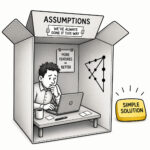
The idiom thinking outside the box describes the ability to think differently, unconventionally, or from a new perspective. The phrase also refers to the need to think beyond the stated or assumed requirements. It requires creative thinking that lead to the creation of novel solutions. In design, creative thinking is often constrained by unvalidated assumptions that "box" us into what we believe is the solution space. The box isn’t real, yet it is treated as such and therefore triggers suboptimal choices and results.

Continue Reading49 • Thinking Outside The Box
Read more about the article 48 • Hofstadter’s Law
Hofstaedter's Law

48 • Hofstadter’s Law

Hofstadter’s Law is a phenomenon which states that “It always takes longer than you expect, even when you account for Hofstadter’s Law.” It describes the widely experienced difficulty of accurately estimating the time it will take to complete tasks of substantial complexity. The fact that it references itself signals that it takes longer even though we are aware and expect that it will take longer. In product design, the law highlights a recurring failure in estimating time for complex tasks - especially those involving creativity, uncertainty, and iteration.

Continue Reading48 • Hofstadter’s Law
Read more about the article 45 • Diderot Effect
Diderot Effect

45 • Diderot Effect

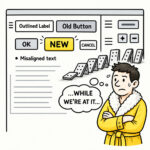
The Diderot Effect describes what happens when an improvement in one part makes everything else feel inconsistent, outdated, or "less than." That initial improvement triggers a cascade of additional changes - not because they were needed, but because now they feel needed. In UX, this is dangerous because it turns focused refinements into sprawling redesigns.

Continue Reading45 • Diderot Effect
Read more about the article 41 • Kitchen Sink
Kitchen Sink

41 • Kitchen Sink

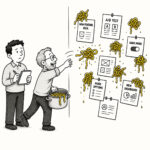
The Kitchen Sink is what happens when an app - or a map - tries to show everything and ends up explaining nothing. At first glance, it looks impressive. Packed. Comprehensive. Full of features, layers, and information. But spend more than a few seconds with it, and the experience quickly shifts from insight to overload. The eye jumps. The interface competes for attention. The meaning gets buried somewhere between panels, controls, and colors. The Kitchen Sink is not a failure of effort. It is a failure of prioritization.

Continue Reading41 • Kitchen Sink
Read more about the article 37 • Cobra Effect
Cobra Effect

37 • Cobra Effect

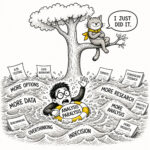
The Cobra Effect describes situations where the metric improves but the experience does not. Nascent product teams often craft incentives with the noblest of intentions: faster growth, happier users, quarterly bonuses; yet sometimes the universe responds not with improvement but with a sharp increase in the very problem they hoped to solve.

Continue Reading37 • Cobra Effect