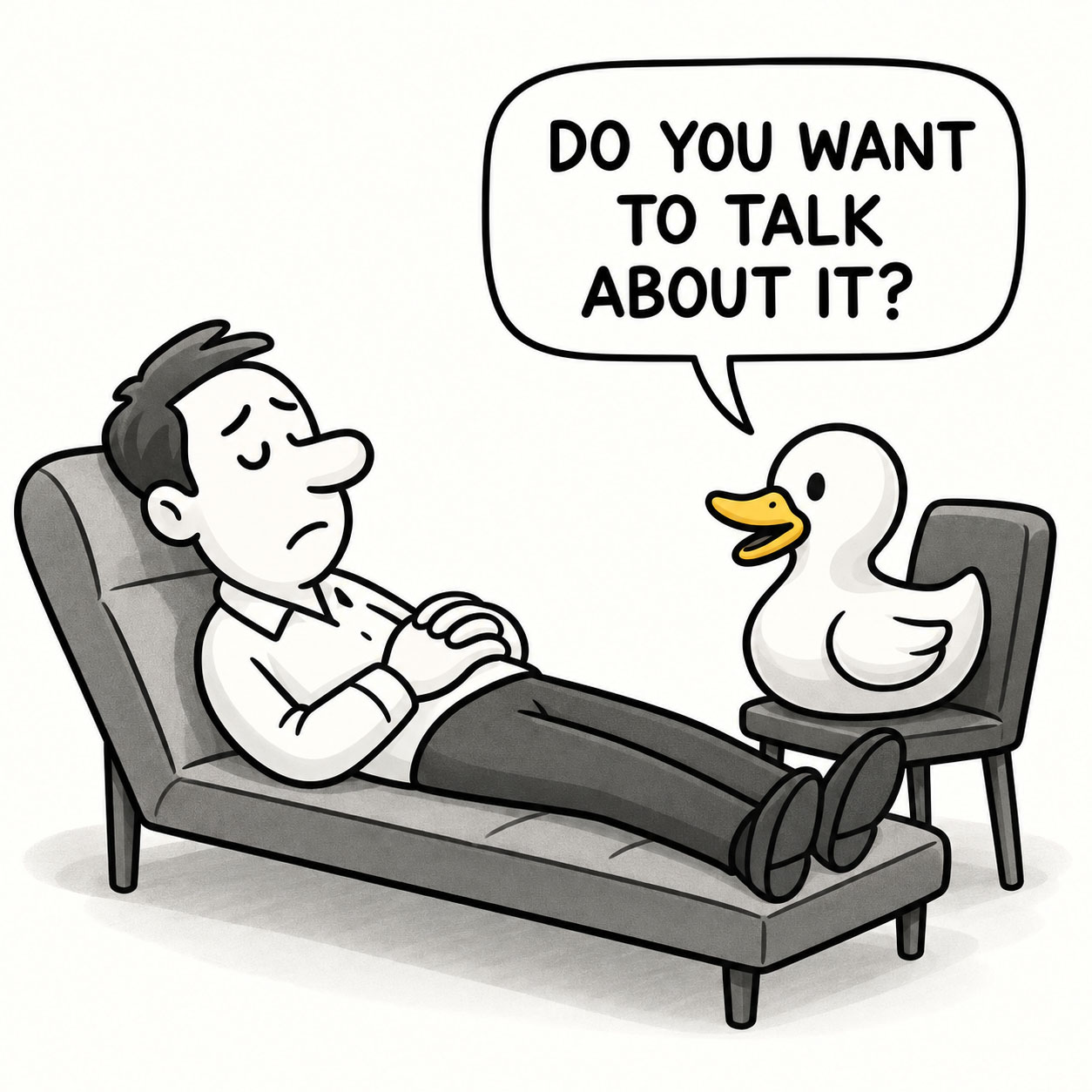
Rubber ducking is the practice of explaining a problem aloud, often to someone (or something) else, to clarify your own thinking and arrive at a solution. In UX and product work, it’s a simple but effective way to unblock yourself or a teammate by articulating the problem clearly.
ORIGIN
The term comes from software engineering, popularized by the book The Pragmatic Programmer, where a developer keeps a rubber duck on their desk and explains bugs to it. The act of verbalizing the issue forces them to think it through more clearly and often leads to a breakthrough.
WHEN
You can use rubber ducking when:
- You’re stuck on a tricky design or usability problem.
- A teammate comes to you for help but figures it out as they explain it.
- You need to sanity-check your own assumptions.
- Writing a design rationale or critique response.
It’s especially helpful when working alone, but just as effective in pair or group settings.
WHY
Explaining a problem aloud engages different parts of your brain and forces you to structure your thoughts. It helps uncover assumptions, gaps, and connections you might not notice in your head.
Plus, sometimes all you really need is an audience, not a solution.
HOW
Here’s how to practice rubber ducking:
- Find an audience. It can be a coworker, a friend, a pet, or even an inanimate object.
- State the problem. Walk through it step by step, clearly and simply.
- Listen to yourself. Pay attention to where your own explanation doesn’t make sense.
- Pause and reflect. Often, you’ll solve it mid-sentence.
- Thank the duck. Even if it just sat there.
PRO TIP
When a teammate rubber ducks with you, resist the urge to interrupt with solutions. Let them finish, you may not need to say anything at all.
EXAMPLES
- A designer explains a confusing flow to a teammate and realizes mid-sentence that the extra step can just be removed.
- A PM walks through user feedback aloud and notices the pattern they missed when reading silently.
- Talking through a bug with a developer, who suddenly blurts, “Oh! I see it now.”
CONCLUSION
Rubber ducking reminds us that clarity often comes from articulation. Sometimes all you need to solve a problem is to hear yourself explain it.
Also known as: Thinking out loud • Explaining to a teddy bear • Talking it through