Hofstadter’s Law is a phenomenon which states that “It always takes longer than you expect, even when you account for Hofstadter’s Law.” It describes the widely experienced difficulty of accurately estimating the time it will take to complete tasks of substantial complexity. The fact that it references itself signals that it takes longer even though we are aware and expect that it will take longer.
In UX and product development, the law captures the maddening difficulty of estimating complex work – especially work involving research, creativity, technology, dependencies, feedback, and humans changing their minds.
ORIGIN
Hofstadter’s Law was coined by Douglas Hofstadter in his 1979 book Gödel, Escher, Bach: An Eternal Golden Braid. Hofstadter introduced it while discussing the development of chess-playing computers. For years, researchers predicted that a computer capable of defeating the world’s best human chess players was roughly a decade away.
A decade would pass. And somehow it remained roughly a decade away.
Hofstadter observed that even when people recognized their history of overly optimistic predictions and adjusted accordingly, they still underestimated how long the challenge would take. Hence his wonderfully recursive law: It always takes longer than you expect – even when you account for the fact that it always takes longer than you expect.
Eventually, of course, computers caught up. In 1997, IBM’s Deep Blue defeated reigning world chess champion Garry Kasparov in a six-game match. It just took longer than people expected. Hofstadter would presumably not have been surprised.
WHEN
You’ve encountered Hofstadter’s Law when:
- One task reveals five more
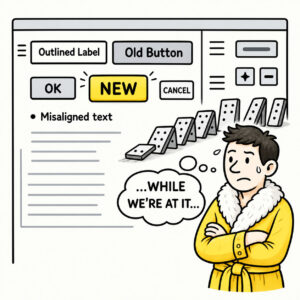
Fix the component. Discover accessibility issue. Find legacy dependency. Update API. Reconsider life choices.
- A feature keeps moving to the next sprint
It has been nearly finished for some time.
- Research creates more questions
You started research to reduce uncertainty. Congratulations on discovering previously unknown uncertainty.
- Implementation reveals what the prototype didn’t
Everything worked beautifully when the database, network, browser, and actual users weren’t involved.
- You hear: “How hard can it be?”
Welcome to the meeting, Herr Hofstadter.
WHY
Hofstadter’s Law isn’t just poor estimation. Complex work is genuinely difficult to predict because we estimate before we fully understand what we’re estimating. This process isn’t linear, it involves multiple stages: research, ideation, prototyping, testing, implementation, and iteration. Each stage with dependencies, constraints, and feedback loops.
That creates the following problems:
- Hidden dependencies exist
What appears to be one task often relies on systems, decisions, people, data, and other tasks nobody noticed initially.
- Feedback changes the work
Research changes requirements. Testing changes designs. Designs expose technical constraints. Constraints change scope. Scope changes estimates.
- Unknown unknowns remain unknown
You can plan for known risks. Planning for something nobody knows exists is considerably trickier.
- Creative work isn’t linear
Design doesn’t reliably progress from 20% finished on Monday to 40% on Tuesday.
- Integration creates complexity
Individual pieces may work perfectly until they have to work together.
- People are part of the system
Reviews get delayed. Stakeholders disagree. Priorities shift. Delays are inevitable.
Even with experience and well-intended buffers: You’re still estimating from incomplete knowledge and based on assumptions.
HOW
Hofstadter’s Law can’t be avoided, but it can be managed by planning for reality instead of precision. Consider the following solution approaches:
- Break work into smaller pieces
Smaller tasks expose hidden complexity earlier and make estimates easier to revise.
- Estimate from evidence
Use previous comparable work, when possible, rather than relying entirely on how simple the new task feels.
- Plan in stages
Research, design, validation, implementation, and refinement reveal new information. Let plans evolve as that information arrives.
- Use ranges where appropriate
An honest range often communicates uncertainty better than an extremely confident date produced from incomplete knowledge.
- Add contingency deliberately
Buffers aren’t evidence of poor planning. They’re recognition that the plan cannot contain everything reality will introduce.
- Test early
The sooner assumptions meet users and technology; the sooner hidden work becomes visible.
- Re-estimate as you learn
An estimate made with new information should be better than one made before the project started. Updating the plan isn’t failure.
PRO TIP
If it feels simple, you haven’t discovered the complexity yet. Once dependencies become clear and complexity increases, communicate and coordinate with other teams, and adapt as we learn.
EXAMPLES
- A “small” UI change reveals responsive, accessibility, localization, and edge-case requirements.
- A design handoff exposes a technical constraint nobody knew existed during design.
- User testing reveals that the proposed solution solves the problem but creates two entirely new ones.
- A component works perfectly alone but requires substantial changes when integrated with the existing product.
- A prototype takes two days to create and three weeks to make production-ready.
- A feature estimated for one sprint enters its third because every implementation step reveals another perfectly reasonable requirement.
CONCLUSION
Hofstadter’s Law reminds us that complex work is difficult to estimate precisely because we don’t yet know everything the work will teach us.
As discovery unfolds and understanding evolves, time expands. The goal isn’t to estimate perfectly but rather to plan for imperfection and adapt along the way.
Good teams estimate. They create milestones, manage dependencies, add contingency, and make commitments. The biggest risk isn’t that the work will take longer than expected. It’s being surprised when it does.