The Cobra Effect is what happens when a well-intentioned solution doesn’t just fail to solve the problem – it makes the problem worse.
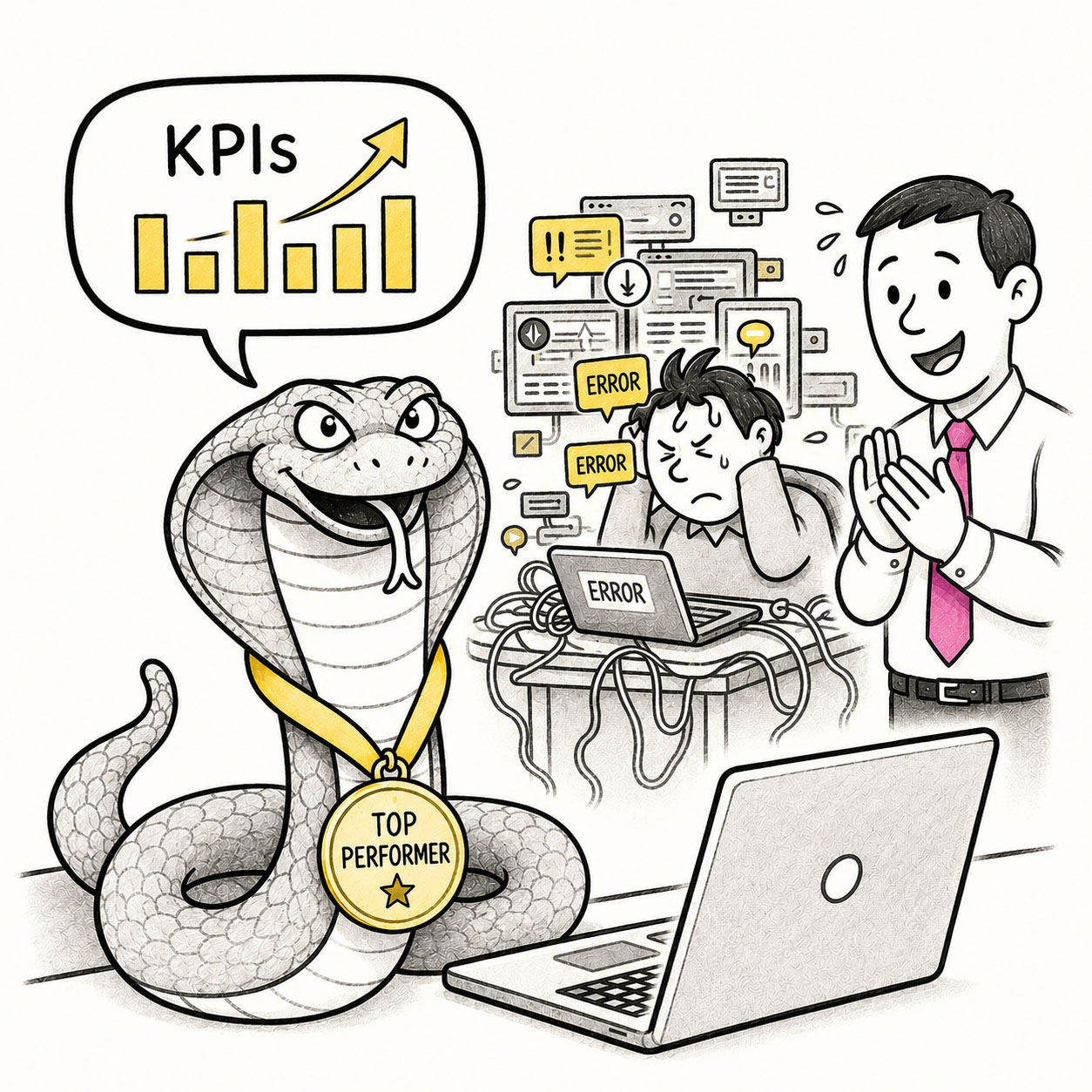
Product teams are particularly good at creating the conditions for this. We introduce a metric to encourage engagement, a target to increase productivity, or an incentive to improve quality. The intention is perfectly reasonable.
Then people adapt. They optimize for the metric, work around the rule, exploit the incentive, or discover an entirely rational behavior nobody anticipated. The dashboard improves beautifully while the actual outcome quietly gets worse.
ORIGIN
The Cobra Effect takes its name from a famous story about British colonial rule in India. According to the tale, officials in Delhi were concerned about the number of venomous cobras and introduced a simple incentive: citizens would receive a bounty for every dead cobra they delivered. Initially, the program appeared to work. Cobras were killed. Rewards were paid. Presumably, someone produced a very encouraging chart.
Then people discovered that breeding cobras was considerably easier than finding them.
Enterprising citizens began raising snakes specifically to kill them and collect the bounty. When officials eventually discovered what was happening, they canceled the program. With the cobras suddenly worthless, breeders released them. The result, according to the story, was even more cobras than before.
WHEN
While you might not find literal snakes in your office – though one never knows – the Cobra Effect can take many familiar design disguises:
- The metric improves while the experience gets worse
Engagement is up. So are complaints, frustration, and churn.
- A new rule creates a new workaround
Users don’t change their goal. They simply discover another route to it.
- Success in one area creates problems elsewhere
The support team closes tickets faster. Customers must now submit three tickets instead of one.
- The incentive becomes more important than the behavior it represents
What began as a proxy for success gradually becomes the definition of success.
- You hear: “But the numbers look great.”
Somewhere, a cobra breeder is smiling.
WHY
The Cobra Effect thrives because incentives change behavior – and humans are remarkably creative about responding to them. Some of the reasons why this happens include the following:
- Metrics are proxies
Task-time, conversion rate, or features shipped represent outcomes we care about – but they aren’t the outcomes themselves.
- People respond to incentives
If you tell a team what will be measured, rewarded, or celebrated, then behavior naturally shifts toward it.
- Systems have side effects
Improving one part of a complex system can create unexpected consequences somewhere else.
- Short-term results hide long-term damage
Aggressive notifications may increase engagement this week while increasing fatigue and churn three months later.
- Optimization finds loopholes
People don’t necessarily violate the rules. Often they follow them with impressive precision while completely defeating their purpose.
These observations overlap neatly with Goodhart’s Law that states that when a measure becomes a target, it ceases to be a good measure.
HOW
The goal isn’t to eliminate metrics or incentives. It’s to design them with their unintended consequences in mind.
- Start with the outcome, not the metric
Define what you’re actually trying to improve before deciding how you’ll measure it.
- Use multiple signals
A single metric is easy to optimize in isolation. Pair engagement with retention, speed with quality, or conversion with satisfaction.
- Look for counter-metrics
Ask what could deteriorate while your primary KPI improves. Measure that too.
- Watch behavior, not just numbers
Qualitative research data and observation can reveal consequences that metrics conveniently hide.
- Measure downstream effects
Don’t declare victory immediately after the number moves. Some cobras take a few months to hatch.
- Watch out for behavior changes
If people begin optimizing the wrong behavior, redesign the system.
PRO TIP
A good metric helps you understand whether you’re achieving the goal. Watch out for the bad metrics that silently become the goal.
EXAMPLES
- Measure success only by time spent: Content becomes harder to leave, infinite scroll appears everywhere, and simple tasks take longer – yet engagement looks fantastic.
- Reward support ticket closure time: Agents close tickets quickly with generic responses. Resolution time improves. Repeat tickets increase.
- Measure developers by tickets completed: Large tasks mysteriously become twelve tiny tickets. Productivity soars – on the task board.
- Reward sales purely by new accounts: Sign-ups increase dramatically, but low-quality customers too.
CONCLUSION
Metrics, targets, incentives, and policies don’t simply measure behavior. They shape it. And once a reward becomes attached to a number, people become remarkably inventive at producing that number – sometimes without producing any real value. The moment you attach reward to a number, behavior bends toward it.
So when the dashboard starts moving in exactly the direction you hoped, don’t celebrate quite yet. Look beyond the metric. Check what behavior changed, what happened elsewhere, and whether the original problem actually improved.
Also known as: Perverse Incentive • Goodhart’s Law in Action • Feature Factory Frenzy