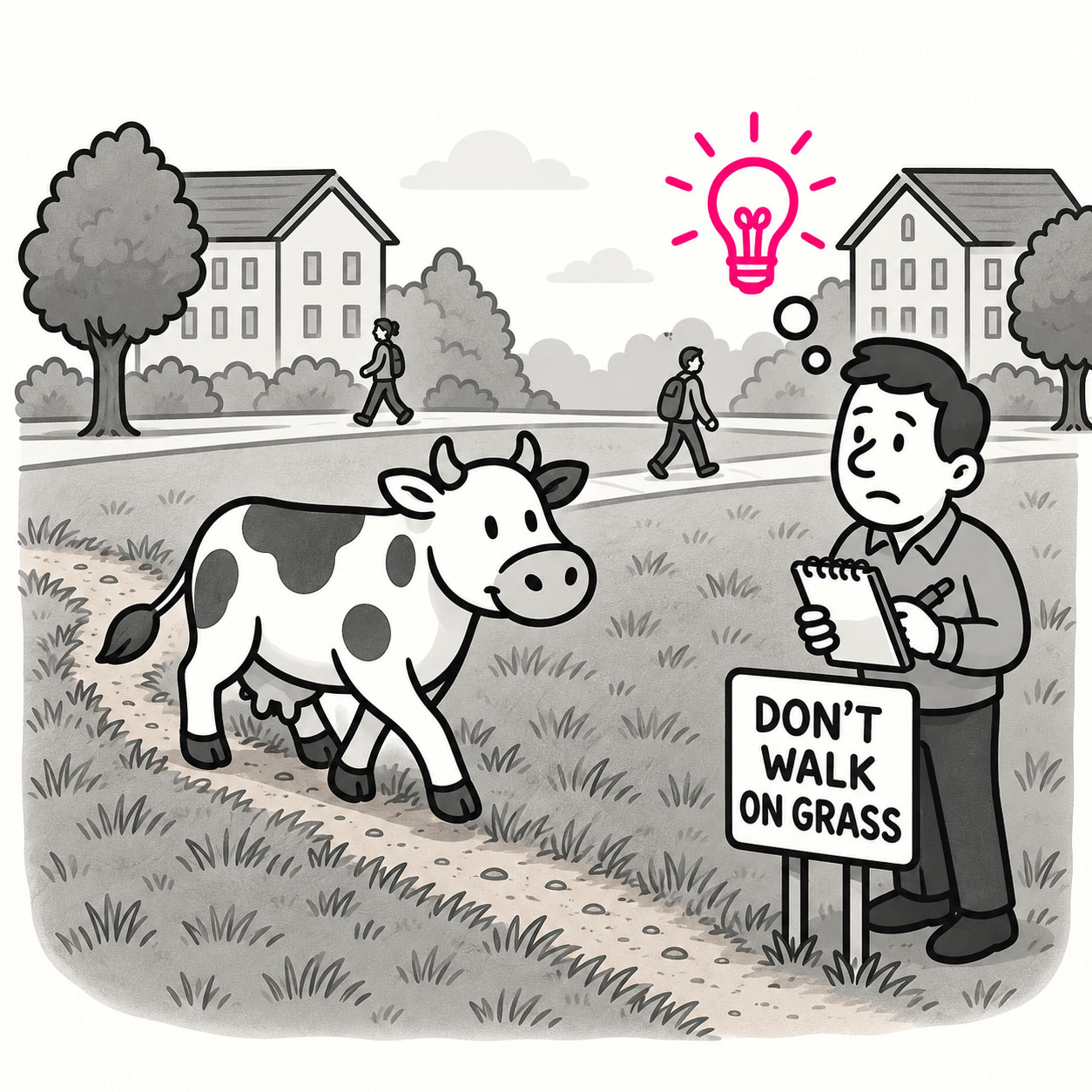
Paving the cow path happens when you formalize and reinforce an existing user behavior or process, rather than designing a completely new one. In UX, it means observing how users already navigate your product, even if it’s messy, and then improving or streamlining that exact behavior, instead of forcing a “better” way that nobody asked for.
ORIGIN
The phrase paving the cow path comes from urban planning. In cities and campuses, planners noticed that pedestrians and cyclists ignored the carefully designed straight sidewalks and instead wore down meandering, diagonal “desire paths” across the grass, the most efficient route from A to B. Rather than fighting this, some cities chose to simply pave over these natural paths, aligning infrastructure with real human behavior. The “cow path” metaphor describes how roads across Europe followed the winding trails made by cattle, reflecting natural movement rather than planned grids.
In design, the idea is the same: don’t fight the habits and instincts of your users, acknowledge them, and improve their experience where they already are.
WHEN
You’ll most often encounter paving the cow path when:
- Users consistently work around your intended flow in creative ways.
- Analytics show most people use an unintended route to accomplish a task.
- Legacy processes or systems have shaped user expectations over time.
- Stakeholders resist radical redesigns and prefer incremental improvements.
It’s especially useful in mature products with established user bases who have already found their “own way” to use the system.
WHY
People form habits, and those habits are powerful. When you try to replace a behavior that users are already comfortable with, you risk frustration, pushback, and poor adoption.
Paving the cow path respects what users already do. It aligns design with actual usage patterns instead of hypothetical ideals. It can also save time and resources by avoiding over-engineering and delivering improvements where they matter most.
HOW
Here’s how to pave the cow path thoughtfully:
- Observe first. Use analytics, heatmaps, and user research to uncover real behaviors, not just the flow you think they’re using.
- Validate patterns. Make sure the path they’re taking is worth supporting long-term and aligns with business goals.
- Improve incrementally. Remove friction and make the existing route more seamless without changing its essence.
- Communicate change. Show users you’ve “heard” them by improving what they already do.
- Avoid codifying bad habits. Be cautious not to reinforce inefficient or harmful behaviors just because they’re common.
PRO TIP
Sometimes it’s smarter to pave part of the cow path while gently nudging users toward a better alternative. This balances respect for their habits with guidance toward improved outcomes.
EXAMPLES
- Observing that most users bypass a guided setup and jump straight to the dashboard, so you streamline and improve the dashboard entry point.
- Realizing customers use a blank “notes” field as a tagging system, so you formalize tags instead of removing the notes.
- Adding a shortcut button to the “Export” feature because data shows users always dig for it.
CONCLUSION
By paving the cow path, you meet users where they are, improve their reality, and earn trust, instead of forcing them down a route they never wanted to take.
Also known as: Formalizing emergent behavior • Designing for what is, not what should be • Incremental UX improvement