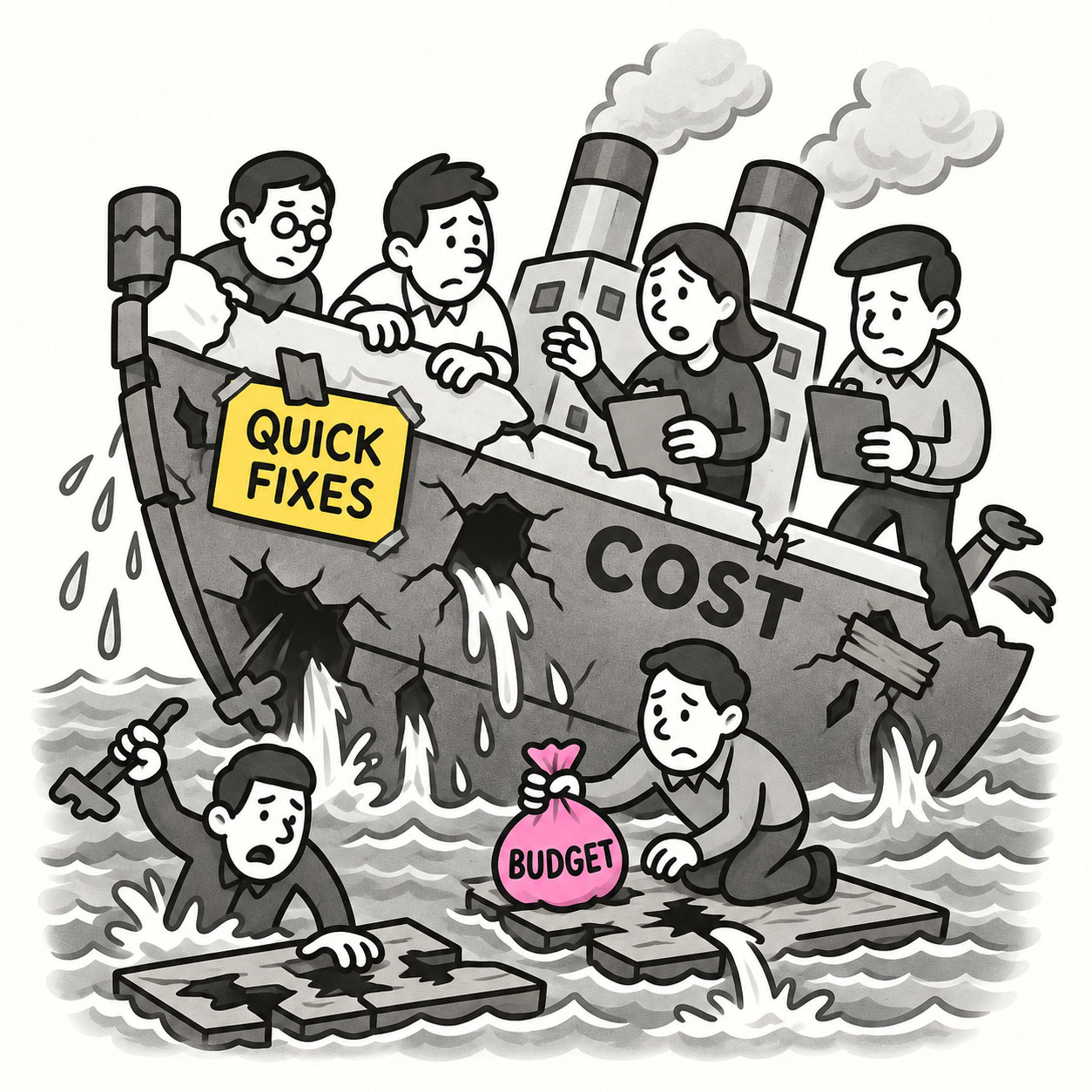
Sunk cost fallacy is the tendency to keep investing time, effort, or money into something, just because you’ve already invested so much, even when it’s clear it’s not working. In UX, this shows up when teams cling to flawed designs, failed features, or outdated systems simply because they don’t want to “waste” what’s already been spent.
ORIGIN
The concept comes from economics and behavioral psychology. Rationally, past costs (sunk costs) should not affect current decisions since they can’t be recovered. But humans hate waste, and we’re wired to double down to “justify” past effort.
In design, this means that teams keep polishing or defending something that should have been scrapped or rethought long ago.
WHEN
You’ll see the sunk cost fallacy in UX when:
- A clunky feature lingers because “we already built it.”
- Redesigns keep patching a broken flow instead of replacing it.
- A legacy system continues draining resources because “migrating would mean wasting past work.”
- Designers defend bad ideas because they spent weeks perfecting the pixels.
WHY
The sunk cost fallacy happens because:
- People feel emotionally attached to their past work.
- Organizations measure effort by input (time, money) rather than outcomes.
- Admitting something isn’t working feels like admitting failure.
- Hope that “just one more tweak” will turn things around.
But clinging to sunk costs often means throwing away more time and money, at the expense of users.
HOW
Here’s how to escape the sunk cost trap:
- Focus on outcomes. Ask: “Does this solve user problems today?” not “How much have we spent?”
- Create kill criteria. Define clear rules for when to pivot or stop a project.
- Celebrate learning. Frame abandoned work as insight gained, not effort wasted.
- Use small bets. Prototype and test before heavy investment to reduce sunk costs in the first place.
- Invite fresh eyes. New team members can question attachments that others are no longer able see.
PRO TIP
When you hear “we’ve already put too much into this to quit,” that’s your red flag. Challenge the team to reframe: “If we were starting today, would we still choose this path?”
EXAMPLES
- A mobile app feature that is barely used but keeps getting design tweaks because it took three sprints to build.
- A navigation redesign that’s been iterated on for months, even though user tests show the structure is fundamentally broken.
- A legacy enterprise tool that’s expensive to maintain but sticks around because rewriting it feels like “throwing away years of work.”
CONCLUSION
The sunk cost fallacy reminds us that good UX isn’t about defending yesterday’s work, it’s about serving today’s users. Sometimes, the bravest design move is to abandon and “paddle” away completely.
Also Known As: Escalation of commitment • Throwing good money after bad • Cost trap