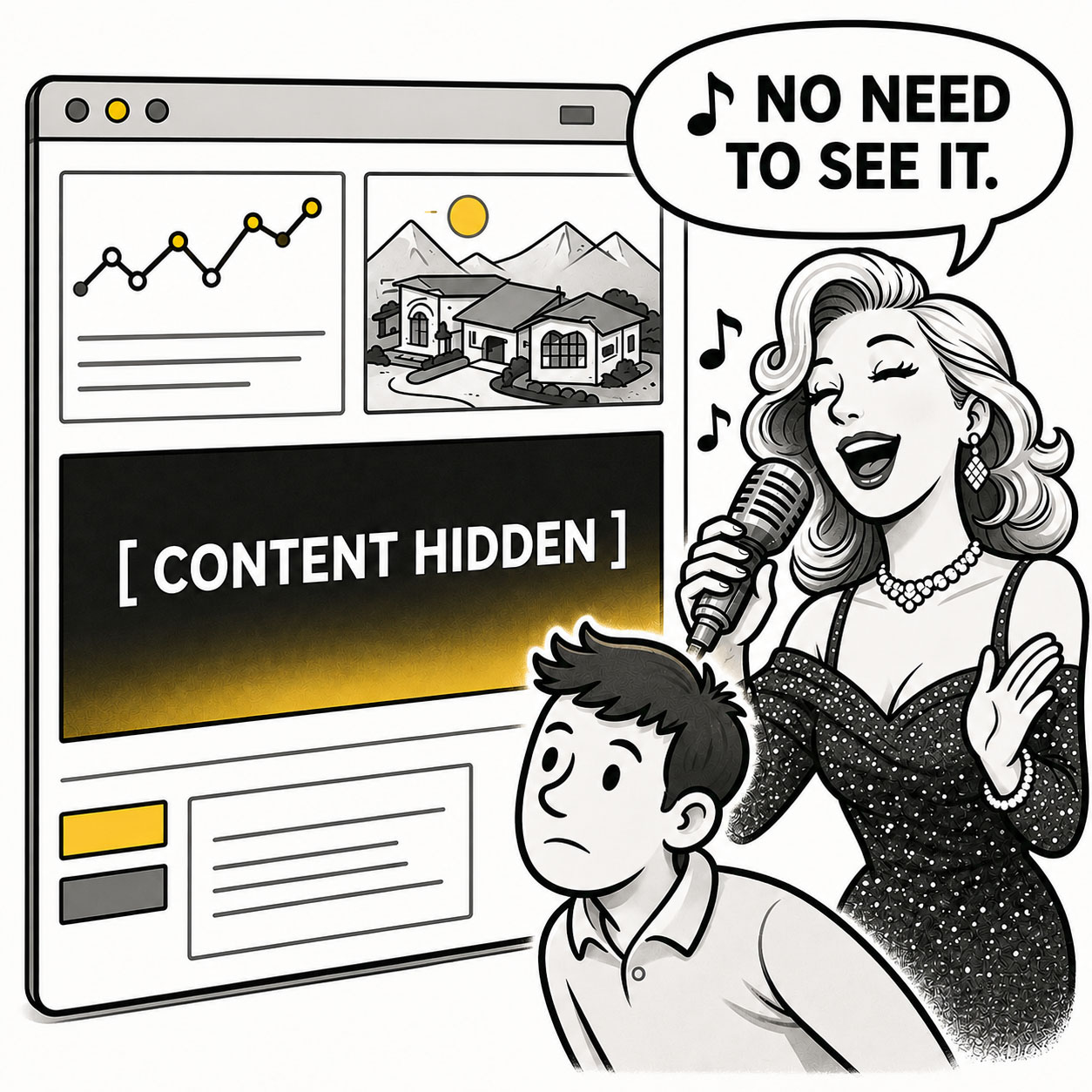
The Streisand effect is a phenomenon where attempts to suppress or hide information makes everyone considerably more interested in it. As a result, this can inadvertently cause it to spread more widely, often creating the opposite of the intended effect.
In UX, it often begins innocently. An inconvenient piece of information moves three menus deeper or a feature disappears without explanation. Users will notice – and now they don’t just want to know what changed. They want to know why you didn’t want them to notice.
ORIGIN
The term comes from a 2003 incident involving American singer and actress Barbra Streisand.
As part of the California Coastal Records Project, photographer Kenneth Adelman had taken thousands of aerial photographs documenting erosion along the California coastline. One of those photographs happened to include Streisand’s Malibu home. Streisand sued Adelman and others in an attempt to have the photograph removed from public circulation, citing privacy concerns.
Before the lawsuit, almost nobody cared; the image had reportedly been downloaded only six times, including downloads by Streisand’s attorneys. The lawsuit itself then attracted widespread media attention, and hundreds of thousands of people visited the project’s website the following month.
In 2005, technology writer Mike Masnick coined the term Streisand Effect to describe this peculiar phenomenon: trying to suppress information can become the very thing that publicizes it, or “if something is hidden, it must be worth seeing.”
WHEN
You’ve encountered the Streisand Effect in UX when:
- A feature quietly disappears
Nobody announced its removal. Users immediately begin asking where it went.
- Important information gets buried
Making something harder to find doesn’t necessarily make people care less about finding it.
- A limitation is carefully obscured
Users discover it anyway. Now you have a limitation and a trust problem.
- A change happens without explanation
In the absence of information, users generously supply their own theories.
- Something gets removed after criticism
The removal becomes a bigger story than the original problem.
- You hear: “Users probably won’t notice.”
A sentence with an impressive historical record of being followed by users noticing.
WHY
The Streisand Effect is driven by attention and trust. The following situations may indicate its presence:
- Hidden things provoke curiosity
If someone doesn’t want us to see something, we naturally wonder why.
- Absence communicates
Users familiar with a product notice when features, options, information, or capabilities suddenly disappear.
- People dislike losing control
Removing access without explanation can make users more motivated to understand what changed.
- Silence creates an information vacuum
When the product doesn’t explain something, users construct explanations themselves.
- Trust magnifies the effect
Once users suspect deliberate concealment, other perfectly innocent decisions can start looking suspicious too.
HOW
The Streisand Effect cannot be prevented by better hiding, that’s the root cause for the problem in the first place. Instead, try doing the following:
- Be explicit about meaningful changes
If a feature disappears or behavior changes, explain what happened when users reasonably need to know.
- Make limitations understandable
Products have constraints. Clear limitations usually create less frustration than limitations discovered unexpectedly.
- Explain the reason when it matters
A short, credible explanation can prevent users from inventing considerably more exciting ones. - Consider the reaction before removing something
A rarely used feature may still be critically important to a small group of users. Usage numbers alone don’t tell the whole story.
- Don’t turn criticism into contraband
Suppressing negative feedback, awkward information, or uncomfortable discussions can give them considerably more oxygen.
PRO TIP
This tip is as simple as it sounds: Don’t try to hide what users will inevitably discover.
EXAMPLES
- A commonly used feature is removed without explanation, prompting backlash and demands for its return.
- A pricing limitation is buried several screens deep, causing users to search for it and question why it was hidden.
- A product quietly changes how a feature works, leading users to speculate about the company’s motives.
- An unpopular option disappears immediately after criticism, drawing more attention to the original criticism.
- A service makes cancellation deliberately difficult, motivating frustrated customers to publicly document exactly how difficult it is.
- A company attempts to suppress an embarrassing piece of information and inadvertently turns it into the story everyone talks about.
CONCLUSION
In user interfaces, the Streisand Effect reveals a simple truth: the absence of something may reveal the presence of something else, even if it’s only about what users feel is being hidden.
Trying to reduce attention often increases it. Trying to avoid friction often results in distrust. Good design doesn’t rely on concealment, rather it relies on clarity. the fastest way to convince people that something is worth looking for is to make it look like you don’t want them to find it.