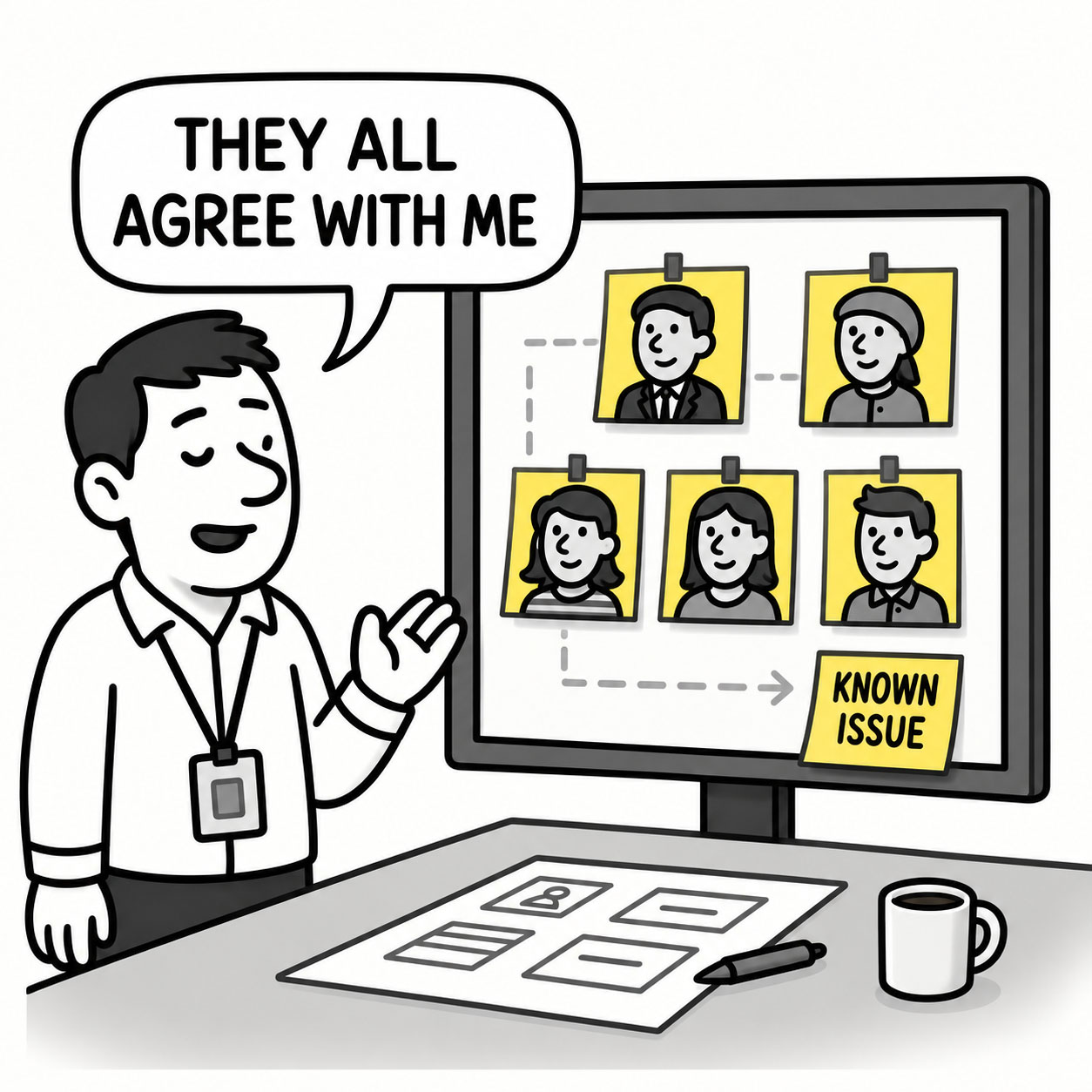
The false consensus effect is the tendency to assume that others share your opinions, beliefs, and preferences more than they do. In UX research, it shows up when small groups, whether participants, stakeholders, or even the design team, mistake their limited perspective for “what users want.”
ORIGIN
The term comes from social psychology research in the late 1970s, when Lee Ross and colleagues found that people routinely overestimate how common their own views and behaviors are.
In design, this bias creeps in when teams interpret limited agreement as proof of universal truth.
WHEN
You’ll see the false consensus effect in UX when:
- Focus group participants nod in agreement, making it seem like “everyone” thinks the same way.
- A designer assumes their own preference (“dark mode is better”) reflects what most users want.
- Stakeholders extrapolate from a few survey responses to claim broad alignment.
- Research findings are generalized without considering diversity in the user base.
It’s particularly risky in group testing sessions, where social pressure amplifies apparent consensus.
WHY
The false consensus effect happens because:
- People want to feel validated in their own choices and beliefs.
- Social dynamics make disagreement uncomfortable in group settings.
- Teams prefer clarity (“this is what users want”) over messy complexity.
- Small samples get treated as representative because they’re easier to act on.
But mistaking false consensus for true consensus leads to designs that reflect the views of a few, not the needs of many.
HOW
Here’s how to avoid falling for the false consensus effect:
- Diversify samples. Don’t rely on one group or one type of user for insights.
- Encourage dissent. In group sessions, actively invite different viewpoints.
- Separate voices. Use individual tasks (sketches, sticky notes) before group discussion.
- Check assumptions. Compare research findings against broader data (analytics, surveys, customer feedback).
- Document variance. Capture not just agreements, but also disagreements and edge cases.
PRO TIP
In workshops, ask participants to silently write down their opinions first. Collecting individual perspectives before an open discussion helps reveal hidden differences.
EXAMPLES
- A usability session where three out of five participants prefer a layout, so the team declares “users prefer this”, ignoring the other two.
- A stakeholder panel where everyone from one department agrees, but their consensus doesn’t reflect other user groups.
- A designer testing a feature with colleagues, who confirms it works because they share the same mental model, unlike real users.
CONCLUSION
The false consensus effect reminds us that real user insight comes from diversity, not uniformity. If it feels like everyone agrees too quickly, dig deeper, you might just be seeing an illusion.
Also Known As: Consensus illusion • False agreement bias • “Everyone thinks like me” trap