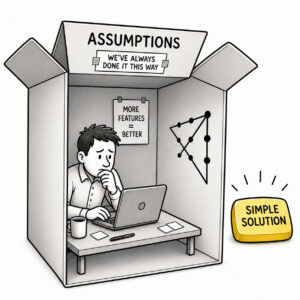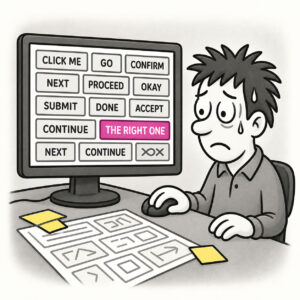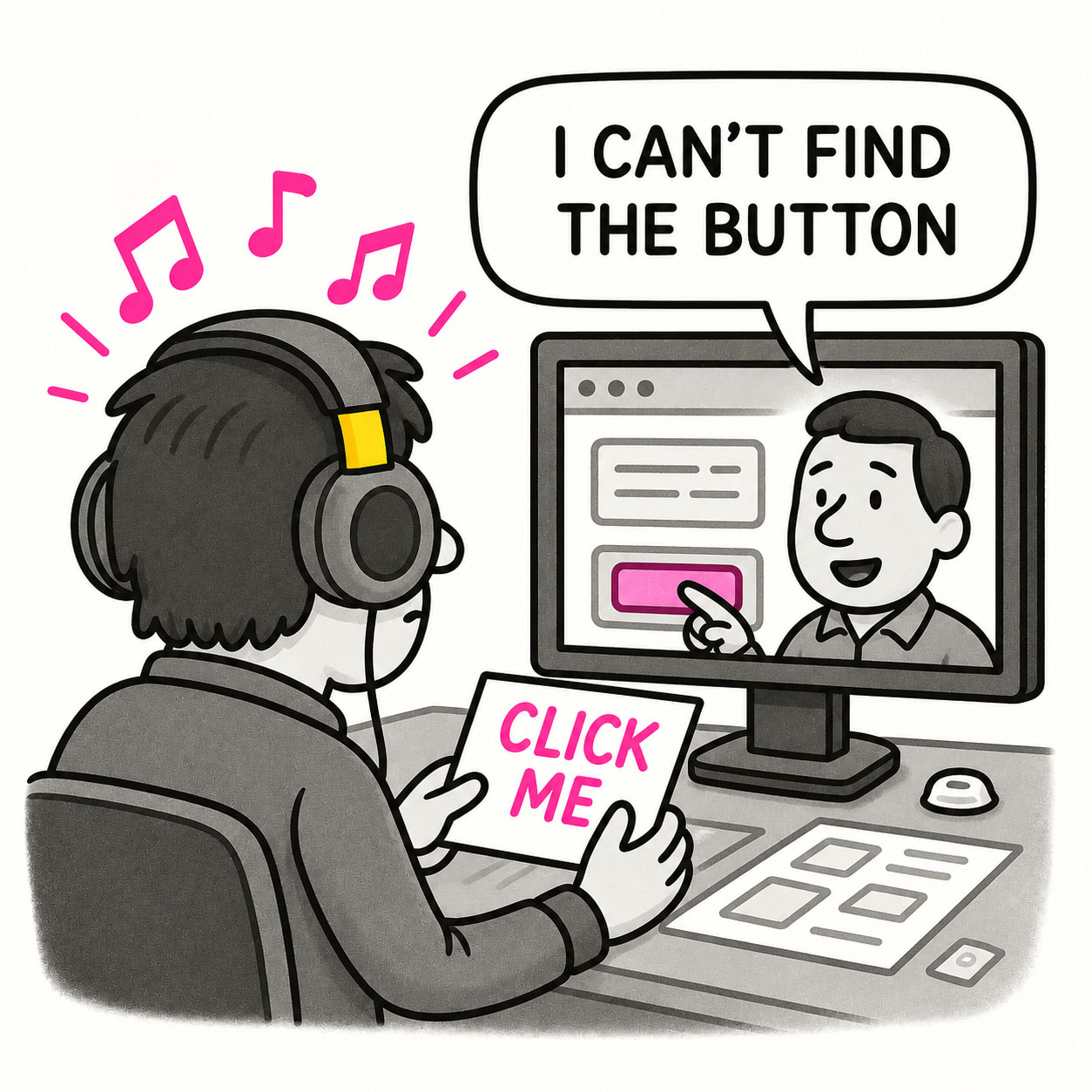
Confirmation bias is the tendency to favor information that confirms what we already believe, while ignoring or discounting evidence that challenges our assumptions. In UX, it shows up when teams interpret user feedback, analytics, or test results through the lens of their preconceived ideas, leading to poor decisions and missed opportunities.
ORIGIN
Confirmation bias is a well-documented psychological phenomenon, first explored in the 1960s by cognitive psychologist Peter Wason. In human behavior, it helps us feel more certain and reduces cognitive dissonance.
In design, though, it’s dangerous, because it can make you blind to real user needs and data that contradicts your narrative.
WHEN
You’re likely to see confirmation bias in UX when:
- Teams selectively highlight feedback that supports their preferred design direction.
- Stakeholders dismiss usability findings as “outliers” when they contradict business goals.
- Test results are cherry-picked to justify a pre-decided change.
- Research questions are phrased in ways that lead to the expected answer.
It’s particularly insidious in environments where senior leaders have strong opinions, or when deadlines pressure teams to “prove” a solution instead of exploring honestly.
WHY
Confirmation bias happens because:
- People want to be right, it feels good to confirm what you already thought.
- Time and resource pressures discourage deep, uncomfortable exploration.
- Teams fall in love with their ideas or designs.
- Disconfirming evidence feels like failure, rather than a chance to improve.
The result? You ship products based on what you think users want, not what they need.
HOW
Here’s how to minimize confirmation bias in your process:
- Ask neutral questions. Phrase interview and survey questions to invite honest feedback, not agreement.
- Include dissenting voices. Encourage diverse perspectives in design reviews.
- Document all findings. Don’t just write down what supports your hypothesis, note what doesn’t.
- Test against yourself. Frame usability and A/B tests as opportunities to learn, not win.
- Rotate roles. Have team members analyze findings independently to cross-check interpretations.
PRO TIP
When presenting research, explicitly share both confirming and disconfirming evidence. It signals honesty and keeps the team grounded.
EXAMPLES
- A product manager dismisses 30% of users struggling with a new feature because “they’re just not our core audience.”
- A team launches a redesign despite test participants consistently expressing confusion because it “tested better overall.”
- A designer asks users: “Do you like how simple this feels?” instead of “How does this feel to you?”
CONCLUSION
Confirmation bias reminds us that great UX is about discovering the truth, not defending our egos. The sooner you let go of being right, the closer you get to getting it right.
Also known as: Motivated reasoning • Cherry-picking • Cognitive tunnel vision