A shared language for product teams
Product teams have a funny habit of running into the same problems again and again.
Features keep creeping. Teams keep bikeshedding. Research gets ignored. Designs get polished long after they should have shipped. And somewhere, someone is still paving the cow path.
The Hitchhiker’s Guide to Design gives those situations names.
It’s an illustrated collection of design metaphors, behavioral effects, mental traps, idioms, and anti-patterns that help product teams recognize what’s happening, talk about it, and – occasionally – even do something about it.
Think of it as part field guide, part survival manual, and part collection of things you wish somebody had mentioned before the meeting started.
Don’t panic. There’s probably a pattern for it.
How the Guide Works
Every pattern starts with a recognizable situation and explores:
WHAT — What exactly is happening?
WHY — Why do smart, well-intentioned teams keep doing this?
WHEN — When should you watch out for it?
HOW — How can you avoid it, reduce it, or escape it?
EXAMPLES — What does it look like in the real world?
Along the way you’ll encounter psychology, UX principles, product strategy, organizational behavior, research, software development, history, and the occasional dragon.
The goal isn’t to memorize terminology.
It’s to recognize the moment when someone around the table says:
“Wait… we’re doing that thing again.”
From 36 Patterns to 78
What started as a collection of 36 design patterns became something bigger.
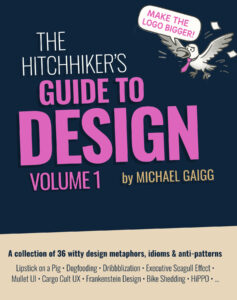
Volume 1
Patterns 01 – 36
From Lipstick on a Pig and Mullet UI to Cargo Cult UX, Design Debt, HiPPO, and Hick’s Law. A collection of 36 witty design metaphors, idioms & anti-patterns.
…don’t panic, there more:
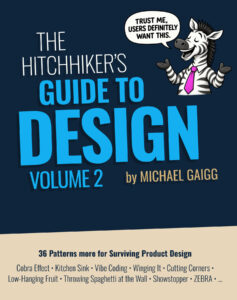
Volume 2
Patterns 37 – 72
More cognitive biases. More organizational dysfunction. More questionable product decisions. More things that seemed like a good idea at the time.
Coming soon – Join the crew and get notified when
Who Is This For?
You don’t need to be a designer to use these patterns.
In fact, they become considerably more useful when everyone on the team understands them.
The Guide is written for people who make digital products:
- UX & UI designers
- Product designers
- Product managers
- Researchers
- Developers & engineers
- Design leaders
- Students & educators
- Stakeholders brave enough to enter a design review
- Anyone who has ever heard “It’s just a small change.”
About Michael Gaigg
Hi, I’m Michael.
I’m a UX designer, design leader, educator, and longtime collector of the strange things that happen when humans try to build digital products together.
Over the years, I’ve noticed that many seemingly complicated design problems aren’t particularly new. Different teams encounter the same behaviors, biases, shortcuts, debates, and spectacularly well-intentioned mistakes.
And many of them already have names. So I started collecting them.
The Hitchhiker’s Guide to Design is my attempt to turn those ideas into something approachable, memorable, and useful – not another textbook, but a field guide you can actually bring into conversations with your team.
If a pattern makes you laugh because you’ve experienced it, that’s good. If it gives your team a name for something you couldn’t quite explain before, even better.
And if somebody says “We’re definitely not doing that” while everyone else slowly looks around the room… Well, that’s probably worth investigating.
Use of AI Disclaimer
Illustrations were created using ChatGPT Plus (GPT-5 through GPT-5.6). Art direction (prompt engineering) and curation (manual editing) by Michael Gaigg.
Proofreading and editing supported by Microsoft Copilot.