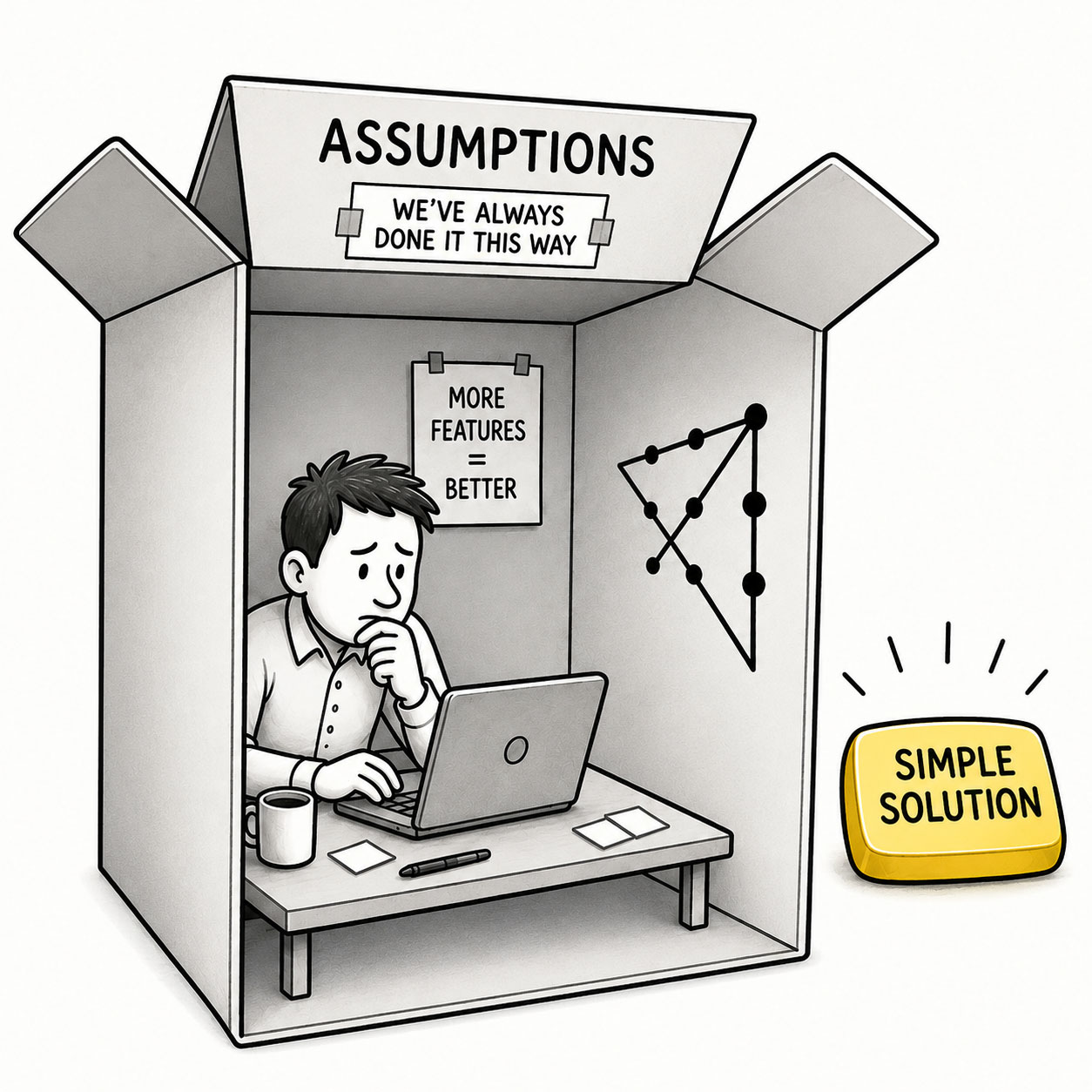
The idiom thinking outside the box describes the ability to approach a problem from a different perspective instead of accepting its stated or assumed boundaries. It also requires to think differently and unconventionally, finding novel solutions simply by asking: “Wait, who said there was a box?”
In design, creative thinking is often constrained by unvalidated assumptions that “box” us into what we believe the solution space is. The box isn’t real, yet it is treated as such and therefore triggers suboptimal choices and results.
ORIGIN
While the real origin of the phrase is unclear, there have been references to think outside the lines as early as 1888. In 1954, the phrase think beyond the boundary got popularized from a classic puzzle: connect nine dots arranged in a square using four straight lines without lifting your pen.
Most people fail because they assume the lines must stay within the square formed by the dots. The solution requires extending lines beyond the implied boundary – thus drawing (or thinking) outside the “box.” The constraint was never stated. It was assumed.
In 1970, the phrase think outside the dots appeared without mentioning the nine dots puzzle, followed by a mention in 1971 to think outside the box, again appearing together with the nine dots puzzle.
WHEN
You may need to think outside the box when:
- A simple problem has an increasingly complicated solution
The team is now designing twelve screens to solve something users wanted to do once.
- You’re endlessly optimizing something that doesn’t work
Version seven is considerably better than version six. Unfortunately, neither should exist.
- Constraints are treated as facts without being validated
“We can’t change that.” Nobody is entirely sure why.
- You hear: “We have to do it this way.”
A useful moment to ask who exactly we and have to are.
- The team is debating implementation before questioning the problem
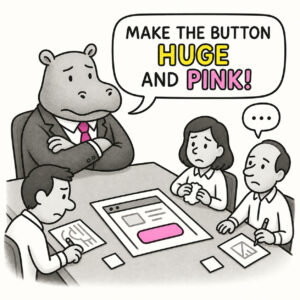
Everyone has opinions about the button. Nobody has asked whether users need the button.
- Iteration stops producing meaningful improvement
Sometimes the problem isn’t the solution. It’s the frame surrounding it.
WHY
The box is usually built from assumptions that have quietly become constraints; they often consist of the following:
- Implicit constraints appear real
People naturally infer rules from context, previous solutions, organizational habits, and the way a problem is presented.
- Problem framing limits solutions
Ask “How should we redesign this menu?” and you’ll probably get menus. Instead, ask “How can users find what they need?” and the solution space becomes much larger.
- Familiar patterns feel safer
Existing solutions provide useful shortcuts, but they can also prevent us from imagining alternatives.
- Teams optimize locally
Improving one part of a workflow can distract from questioning whether the workflow itself makes sense.
- Existing systems shape future thinking
Products accumulate technical constraints, business rules, design patterns, and historical decisions. Eventually, “that’s how it works today” quietly becomes “that’s how it must work.”
HOW
Thinking outside the box doesn’t mean being wildly creative. It means removing invisible constraints. Consider the following approaches to think outside the box:
- Reframe the problem
Ask what users are actually trying to accomplish rather than how to improve the existing solution.
- Make assumptions visible
Write down what the team believes must be true. Invisible assumptions are considerably harder to challenge.
- Separate constraints from conventions
Legal requirement? Technical limitation? Business decision? Existing pattern? Habit? These are not the same thing.
- Temporarily remove a constraint
Ask what you’d design if a particular limitation didn’t exist. Even if the constraint ultimately remains, the exercise can reveal alternatives.
- Solve for outcomes, not implementations
“We need users to provide accurate information” creates more possibilities than “We need a better form.”
- Question the existing workflow
Before improving six steps, ask whether all six steps need to exist.
- Explore deliberately different approaches
Don’t generate ten variations of the same idea and call it divergent thinking. Instead, separate teams and design in isolations for some time.
- Bring reality back in
Eventually, the solution still has to work. Thinking outside the box expands the solution space; it doesn’t exempt you from physics, budgets, accessibility, or engineering.
PRO TIP
If the solution feels complicated, be open minded and challenge the box. Ask: “How will this help our user?”, “What else could we do to make their experience more delightful?”, and “What are the actual boundaries of the problem?”
EXAMPLES
- Replacing a multi-step form with one smart input instead of optimizing every individual field.
- Providing intelligent defaults instead of asking users to configure everything upfront.
- Automating a repetitive task instead of designing a better interface for performing it manually.
- Eliminating an approval step instead of making the approval screen easier to use.
- Letting the system infer information that users previously had to enter themselves.
CONCLUSION
Thinking outside the box is about thinking imaginatively and creatively. It all starts by challenging arbitrary or imagined constraints. Breaking the routine and unquestioned requirements will allow space for fresh approaches and new concepts.
Don’t let your thinking be contained to a small square of knowledge, learn to branch out and discover new ideas. A better solution is often only a small step away, a step outside a comfortable box into unfamiliar territory.