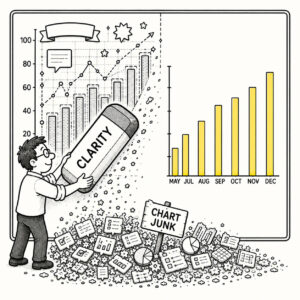
Gold Plating is a term that means working on a project or task past the point of diminishing returns. It refers to the practice of adding extra features or “polishing” designs beyond the agreed scope without measurably increasing quality.
In UX, designers sometimes try to improve the look and feel with the desire to exceed expectations, often not realizing that their extra effort doesn’t add real value to the user experience. Instead, it introduces unnecessary cost and potential technical debt as these extras take time and go undocumented.
ORIGIN
The term “gold plating” comes from manufacturing, where a thin layer of gold is applied to the surface of another material. Used carefully, this practice can, of course, be perfectly useful. It may improve appearance, corrosion resistance, conductivity, or other properties without requiring an object to be made entirely from gold. But used excessively, even when well intentioned, it adds unnecessary cost and time.
Engineering adopted the term to describe work that goes beyond requirements – enhancements that are technically impressive, aesthetically pleasing, yet strategically unnecessary.
In other words: Work that makes the team proud… and the roadmap nervous.
WHEN
You’ve encountered Gold Plating when:
- A finished feature keeps getting “one more improvement”
Done remains tantalizingly close while moving at approximately the same speed as the team.
- Polish starts delaying delivery
The important work is complete. The release apparently needs another week to become emotionally ready.
- Minor details receive major attention
Users can’t complete onboarding, but the hover state is exquisite.
- Rare edge cases receive perfect solutions
Three hypothetical users are about to have an extraordinary experience.
- The team debates preferences instead of outcomes
Everyone has strong feelings about shadows. Nobody has checked the usability data.
- Something gets added because “it would be nice”
Perfectly valid reason for the backlog, but less convincing for delaying Friday’s release.
- You hear: “It’s almost perfect.”
There is no known roadmap beyond this point.
WHY
Gold Plating is powered by several perfectly understandable human instincts:
- Pride in craft
Designers and engineers want to produce work they’re proud of.
- Perfection feels safer than shipping
As long as we’re improving something, we don’t have to expose it to the inconvenient opinions of actual users.
- There is always something to improve
No interface is every really finished.
- “Done” hasn’t been defined
Without clear success criteria, completion becomes subjective.
- Visible polish feels productive
Improving something tangible can feel more satisfying than tackling ambiguous structural problems.
- The enjoyable work wins
Resolving organizational dependencies is exhausting. Tweaking a button is delightful.
HOW
Gold Plating doesn’t require lowering your standards. It requires knowing where additional quality is worth its cost. The following tips will help to set boundaries:
- Define “done” before you start
Agree on requirements, quality expectations, and success criteria while everyone is still capable of rational thought.
- Ask what the improvement changes
Does it improve task success, comprehension, accessibility, reliability, trust, or another meaningful outcome? Or does it mostly make the team happier when looking at it?
- Compare value with effort
A tiny improvement may still be worthwhile if it’s cheap.
- Fix what’s broken before polishing what works
A beautiful secondary interaction doesn’t compensate for a frustrating primary journey.
- Timebox refinement
Give polish appropriate space rather than allowing it to become an indefinitely renewable resource.
- Separate needs from nice-to-haves
Capture worthwhile ideas without automatically absorbing them into the current scope.
PRO TIP
Leave your ego at the door and weigh the benefits of increased quality with the cost of designing and subsequently building it. Re-evaluate your biases towards the product regularly. Don’t fall in love with your ideas.
EXAMPLES
Examples of gold plating include the following:
- Perfecting hover states while users can’t complete the main task
- Spending hours adjusting spacing on a rarely used screen
- Adding elegant animations to a confusing workflow
- Building edge-case perfection for cases that rarely exist
- Delaying launch because “this one thing still bothers me”
CONCLUSION
Gold Plating reminds us that making something better and creating more value are not always the same thing.
Craft matters. Details matter. Polish matters. Great products rarely emerge from teams that stop caring the moment something technically works. But quality has diminishing returns.
Gold plating quietly delays product design. It turns progress into perfectionism, and priorities into preferences. The hardest part of great design isn’t making things better; it’s stopping when they’re already good enough.
Remember that task success always trumps aesthetics. If only your team notices the improvement, it’s probably gold plating.