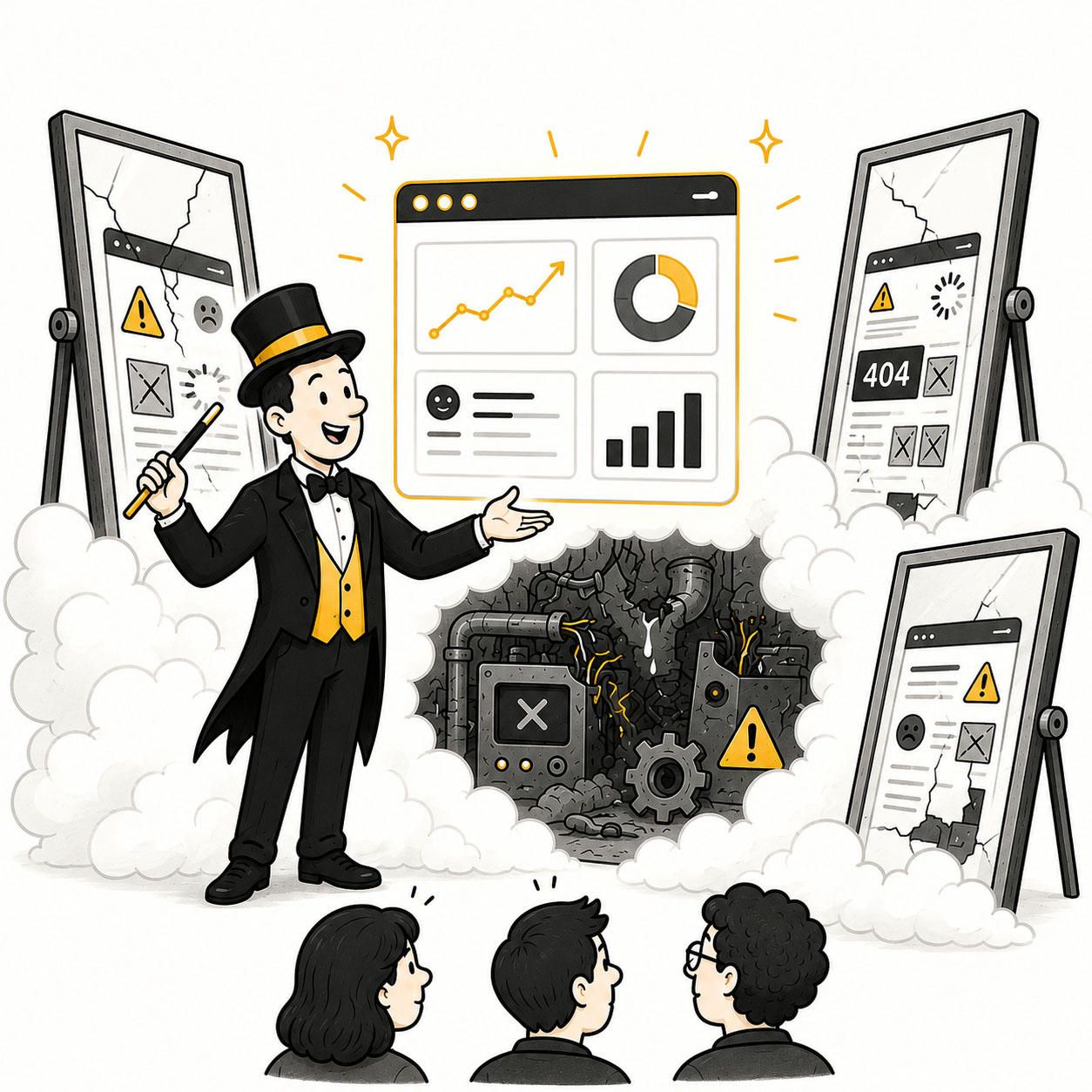
Smoke and Mirrors describes deceptive, misleading, or heavily embellished information used to disguise an unpleasant truth or make something appear better than it is.
In UX design, smoke and mirrors refers to design illusions such as high-fidelity prototypes or deceptive micro-interactions that make a product feel highly functional, responsive, or simple on the surface while masking deep back-end complexity or missing features.
ORIGIN
The phrase “smoke and mirrors” dates back to 19th-century phantasmagoria and stage magic, where illusions are created using reflective surfaces (mirrors) and visual distractions (smoke) to make the impossible appear real. The trick isn’t in changing reality, it’s using optical illusions to control what the audience sees.
In product design, the concept refers to something intended to disguise or draw attention away from an embarrassing or unpleasant issue. Instead of solving underlying problems, teams sometimes rely on presentation, animation, or messaging to create the impression of quality, performance, or intelligence. The experience feels polished, even when the fundamentals are incomplete.
WHEN
Smoke and Mirrors is used in a variety of situations, from faking backend functionality to using high-fidelity prototypes or deceptive UI patterns. There is a lot of value when used intentionally as a fast testing method like in Wizard of Oz Testing. But when taken too far, it becomes an anti-pattern and can be detected in the following situations:
- Animations hide delays
Loading is disguised as “progress.”
- Interfaces feel faster than they are
Perceived performance replaces actual performance.
- AI appears smarter than it is
Confidence in tone masks uncertainty in output.
- Complexity is hidden, not reduced
The problem still exists – just out of view.
- You hear: “Users won’t notice”
And hope becomes part of the design strategy.
If the experience relies on perception more than reality, the illusion is doing the work.
WHY
Smoke and Mirrors is driven by pressure and may be found in any of the following situations:
- Desire to impress
A polished experience feels like a finished product.
- Time constraints
It’s faster to mask a problem than to solve it.
- Perception over performance
If it feels fast, it might be “good enough.”
- Stakeholder expectations
Demos need to look right – even if they aren’t.
- Short-term wins
Illusions work… until they don’t.
The result is a product that performs well in presentations and demos – but poorly in reality.
HOW
Smoke and Mirrors isn’t always wrong. But it becomes dangerous when illusion replaces improvement. The following tips help you alleviate smoke and mirrors:
- Use perception to support reality
Use of skeleton loaders and transitions can visually improve the experience – but they should not hide broken systems.
- Fix root problems first
Performance, clarity, and usability should not depend on visual distraction.
- Be honest in feedback
If something is loading, isn’t done yet, or uncertain, say so.
- Avoid overconfidence in design
Tone, animation, and UI polish should not imply more than the system can deliver.
- Test beyond the demo
What works in a controlled environment must hold up in real use.
PRO TIP
If it only works when no one looks too closely, it doesn’t work. Good design must guide perception but it should never depend on deception.
EXAMPLES
Examples of smoke and mirrors include the following:
- An AI response that sounds confident but is factually incorrect
- A dashboard that looks real-time but refreshes infrequently
- A demo that performs perfectly – but only with prepared and controlled data
- A “fast” interface that hides actual delays with transitions
CONCLUSION
Smoke and Mirrors is a reminder that perception is powerful when used intentionally, but fragile when applied to deceive. A well-designed illusion can improve the experience but abusing illusions to distract from poor implementation or performance will hurt you in the long run.
Be clear what is real and what is smoke and mirrors because once the illusion fades and reality sinks in, the experience suffers, users are upset, and trust is eroded.