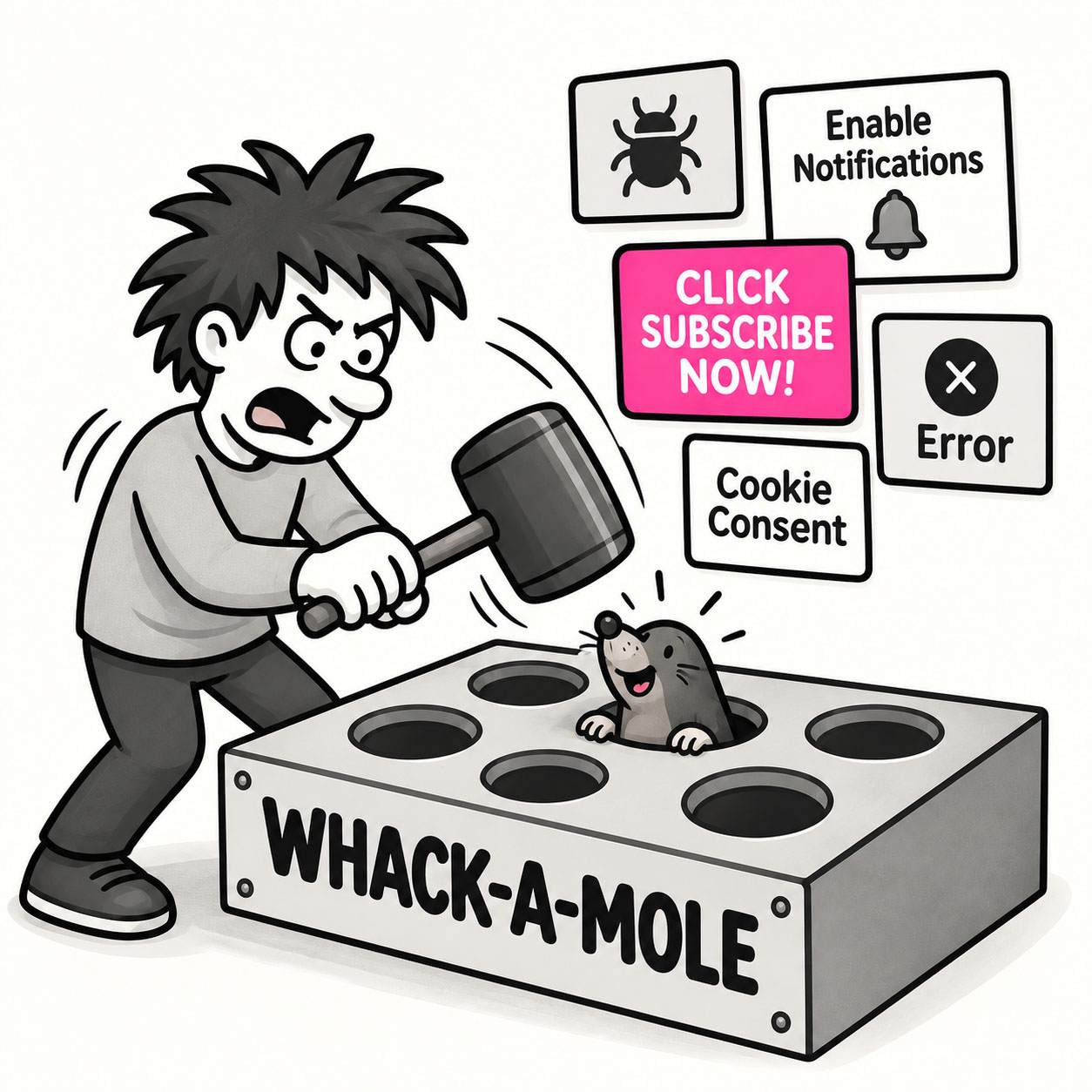
Whack-a-Mole describes a frustrating pattern where fixing one usability problem seems to create another, often in a different part of the system. It’s what happens when you address symptoms instead of root causes, leaving teams trapped in an endless cycle of reactive fixes.
ORIGIN
The term comes from the arcade game Whac-A-Mole, where players hit one mole back into its hole, only to have another pop up somewhere else.
In UX, it became a metaphor for what happens when design, product, and engineering teams make isolated, short-term fixes without taking a holistic view of the experience.
WHEN
You’ll see Whack-a-Mole behavior when:
- Fixing one confusing interaction makes another part of the flow worse.
- Changes in one component break alignment or consistency elsewhere.
- Teams respond reactively to support tickets or A/B tests without stepping back.
- Stakeholders demand quick fixes that don’t address the underlying problem.
It’s especially common in legacy products with lots of interdependencies, or in organizations that lack a shared design system.
WHY
Whack-a-Mole happens because:
- Teams work in silos, unaware of downstream effects.
- There’s no time or appetite for a bigger redesign.
- Decisions are made under pressure, without considering the whole user journey.
- The product has accrued so much UX debt that small changes ripple unpredictably.
The result is a fragile, inconsistent experience, and a team that feels like they’re always playing catch-up.
HOW
Here’s how to stop playing Whack-a-Mole:
- Step back. Map the full user journey to see how changes affect the whole system.
- Fix root causes. Identify underlying usability problems instead of just surface symptoms.
- Use a design system. Enforce consistency and reduce unintended side effects.
- Test broadly. Validate changes not just in isolation, but in the context of real flows.
- Plan strategically. Schedule time to address foundational issues rather than just quick wins.
PRO TIP
Keep a UX debt log. Tracking recurring pain points helps you prioritize holistic fixes instead of reactive patches.
EXAMPLES
- Fixing one menu label to improve clarity but making the navigation inconsistent elsewhere.
- Adding a tooltip to explain confusing behavior, instead of fixing the confusing behavior itself.
- Adjusting spacing in one form, only to break alignment in another.
CONCLUSION
Whack-a-Mole reminds us that great UX comes from systems thinking, not just spot fixes. Stop chasing moles, start redesigning the field.
Also known as: Design ping-pong • Patchwork UX • Reactive design