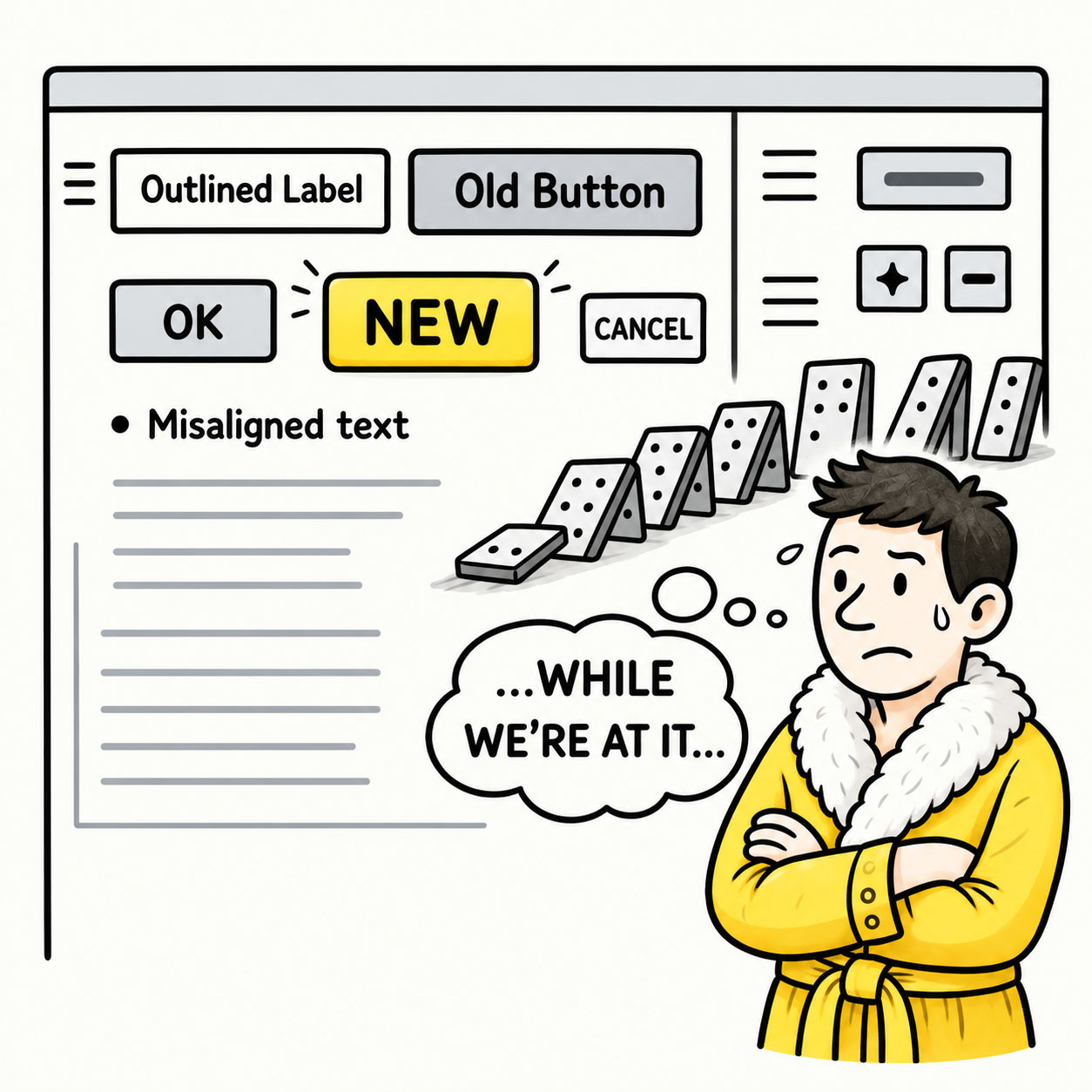
The Diderot Effect describes what happens when you improve one thing and suddenly everything around it looks terrible. That initial change triggers a cascade of additional changes – not because they were needed, but because now they feel needed.
In UX, the Diderot Effect describes how one improvement can raise the perceived standard for everything around it, triggering a cascade of additional changes that weren’t part of the original plan.
ORIGIN
The effect takes its name from Denis Diderot, the 18th-century French philosopher and writer.
In his essay Regrets on Parting with My Old Dressing Gown, Diderot described receiving a luxurious new scarlet dressing gown. It was considerably nicer than his old one. This should have been good news.
Instead, the elegant new robe made the rest of his possessions appear shabby by comparison. His chair no longer seemed good enough. His desk felt wrong. Other belongings were replaced as Diderot attempted to restore harmony between his magnificent new gown and everything surrounding it. One upgrade had changed his standard for the entire room.
This phenomenon was later named the Diderot Effect – the psychology of sequential consumption and coherence pressure that follows an initial upgrade. The concept has since been applied beyond possessions to behavior, consumption, and design patterns.
WHEN
You’re experiencing the Diderot Effect in UX when:
- One updated component makes everything else look old
The new component looks excellent. Congratulations. You now dislike the other forty-seven.
- A quick fix develops a roadmap
What began as a two-day improvement now has phases.
- A visual refresh exposes inconsistencies everywhere
Typography reveals spacing. Spacing reveals grids. Grids reveal layout. Nobody mention navigation.
- The new standard starts spreading
Once one part of the product reaches a higher level of polish, adjacent areas suddenly feel unacceptable.
- Perfectly adequate things become difficult to tolerate
They were fine on Monday. Then Tuesday’s redesign happened.
- You hear: “While we’re at it…”
The official mating call of expanding scope.
WHY
Improvements don’t exist in isolation. When one artifact changes, everything connected to it suddenly becomes visually or conceptually misaligned. The contrast between the upgraded part and the rest becomes a spotlight on imperfection.
In product design, this creates systemic pressure that can be observed in the following situations:
- Contrast exposes inconsistency
A polished component makes older components look noticeably less polished.
- Coherence feels important
Users and designers expect related things to look and behave like they belong to the same product.
- Standards move
Once we’ve seen a better version, the previous version becomes harder to accept.
- Improvements reveal hidden debt
A new pattern can expose inconsistencies that were always there but weren’t obvious until something better appeared beside them.
- Changes create dependencies
Components share typography, spacing, interactions, tokens, layouts, and behaviors. Updating one can legitimately affect others.
HOW
The Diderot Effect begins when “this could also be better” quietly becomes “therefore we must fix it now.” The goal is to decide how far the ripple should travel before it starts traveling on its own. Consider the following during design:
- Zoom out before changing anything
Understand where the component, pattern, or experience appears and what depends on it.
- Define the boundary upfront
Be explicit about what this project will improve – and what it won’t.
- Note likely ripple effects
Identify connected components, screens, behaviors, design tokens, and workflows before the work begins.
- Separate broken from merely older
Something looking less polished than the new design doesn’t automatically make it unusable.
- Capture follow-up work without absorbing it
A redesign can reveal legitimate improvements without requiring them all to become part of the current project.
- Prioritize consistency where it matters
Focus on heavily used and core components.
- Know when to stop
“Better” has no natural finish line. Projects need one.
PRO TIP
Never design in isolation or hyper-focused on a single component or part of the system. Before upgrading, always zoom out to see the big picture, consider the implications of a seemingly small change and decide how far the ripple could go.
EXAMPLES
Examples of decisions that may trigger the Diderot Effect include the following:
- Redesigning a single module leads to revisiting every screen to “match the new quality.”
- A new design system component exposes mismatched legacy components.
- You update spacing and suddenly notice misaligned grids everywhere.
- A polished onboarding flow makes the rest of the journey feel rough.
- Refining an interaction pattern causes a wave of regressions in unrelated areas.
CONCLUSION
The Diderot Effect turns improvements into commitments. It reminds us that design is systemic and every enhancement will raise the bar for everything around it. It should also remind us that sometimes this will also raise the bill.
Understanding the Diderot Effect helps teams anticipate scope, distinguish necessary evolution from cascading rework, and make informed decisions about what to refine – and what to leave well enough alone.