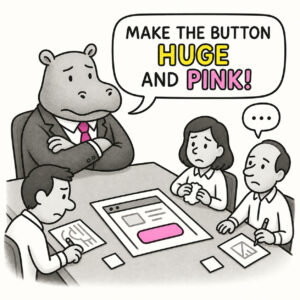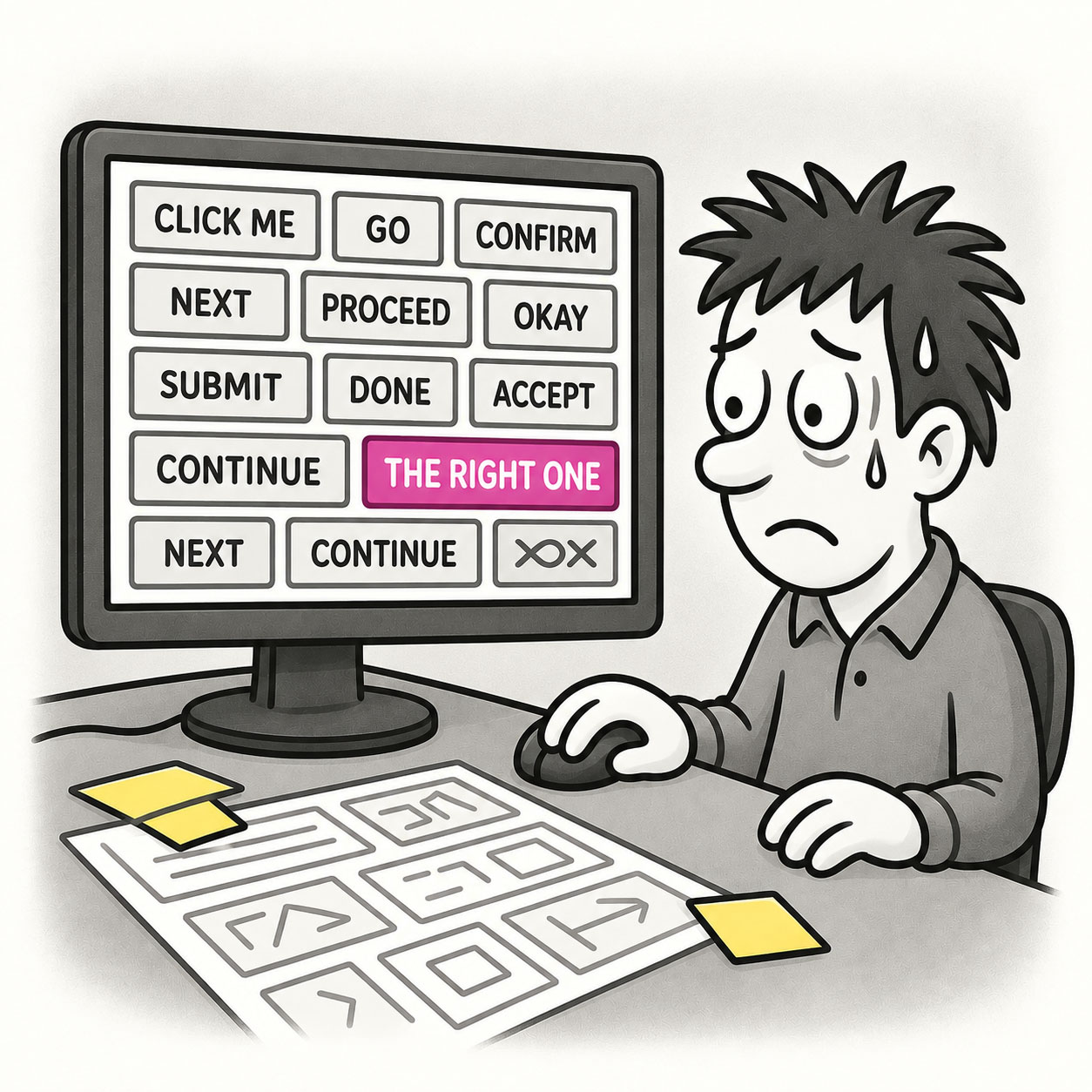
Hick’s Law describes how the time it takes a user to decide increases with the number (and complexity) of choices presented. In UX, it’s a reminder that cluttered interfaces and excessive options slow users down and create cognitive overload.
ORIGIN
Named after British psychologist William Edmund Hick, who, along with Ray Hyman, formulated the principle in the 1950s. Their experiments showed that decision time grows logarithmically as the number of stimuli (choices) increases.
In digital design, it became a cornerstone of design thinking to simplify choices to help users act faster and with less friction.
WHEN
You’ll see Hick’s Law in action when:
- A navigation menu offers dozens of competing links.
- A form has too many confusing options or fields.
- A dashboard overwhelms users with widgets and data points.
- A product configurator forces users to pick from endless tiny variations.
It’s especially problematic in e-commerce, analytics, and any product where speed of decision-making matters.
WHY
Humans have limited cognitive processing power. The more choices you throw at them, the longer they take to decide, and the more likely they are to make mistakes, second-guess themselves, or abandon the task entirely. Simplifying choices helps users feel more confident and speeds up their journey.
HOW
Here’s how to apply Hick’s Law in practice:
- Reduce clutter. Remove or hide irrelevant options wherever possible.
- Group logically. Organize choices into clear, digestible categories.
- Prioritize actions. Highlight the most common or recommended paths.
- Progressive disclosure. Reveal advanced options only when users need them.
- Test and iterate. Watch where users hesitate and refine accordingly.
PRO TIP
Don’t oversimplify to the point of removing meaningful choice, balance clarity with flexibility by showing the right choices at the right time.
EXAMPLES
- A landing page that focuses on one clear call-to-action instead of five competing buttons.
- A simplified product filter that helps users narrow down results step by step.
- A checkout form that shows the most common shipping options up front, with “more options” hidden under a link.
CONCLUSION
Hick’s Law reminds us that more isn’t always better. Help users by designing for clarity and focus, because every extra choice is a little bit more friction.
Also known as: Choice overload • The paradox of choice (closely related concept in psychology) • Decision fatigue