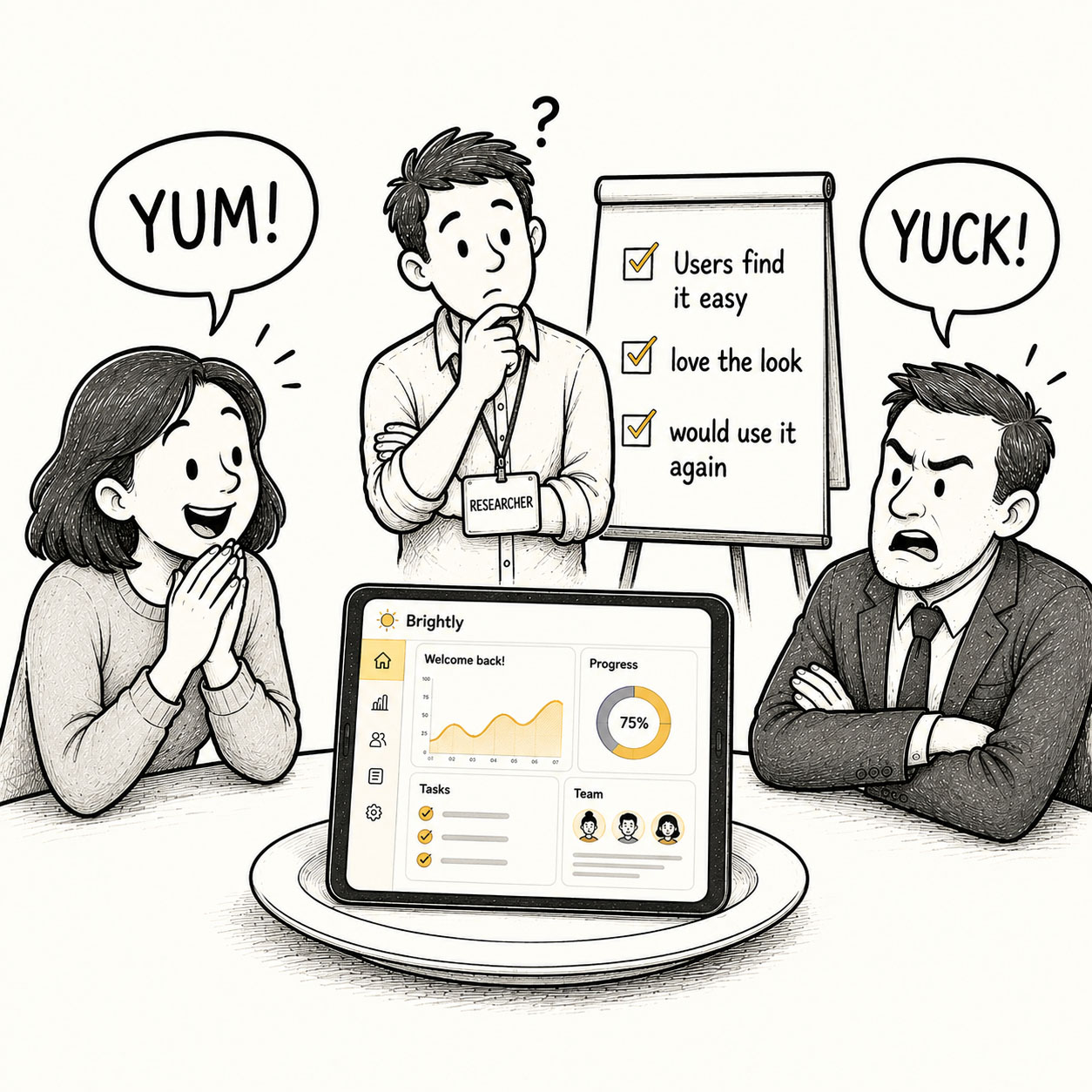
Don’t Yuck My Yum means that one shouldn’t criticize or make fun of something that someone else enjoys. Everyone has different taste and opinions, and that’s perfectly normal. The problem begins when “I don’t like this” quietly transforms into “this is bad design.”
In UX, taste matters – but it isn’t evidence. A design doesn’t become wrong simply because it isn’t what you would personally choose. Someone loves the bold colors. Someone else thinks they’re hideous. One person wants more whitespace. Another thinks the screen looks empty. The designer loves the animation. The product manager would very much like it to stop moving. Personal preference shouldn’t by mistaken for design critique.
ORIGIN
The origin of “don’t yuck my yum” can be traced back to the intersection of food culture and social media, particularly among younger generations who often share their culinary experiences and personal preferences online. The phrase gained popularity in the 2010s as a way to combat negativity and promote acceptance in discussions around food and lifestyle choices. Since then, it has expanded to fashion, music, hobbies, lifestyles, and just about anything else humans can develop surprisingly strong opinions about.
WHEN
If the strongest evidence against a design is someone’s personal reaction to it, somebody may be yucking somebody else’s yum. Other signs for encountering Don’t Yuck my Yum include the following:
- Personal preference becomes design feedback
“I don’t like blue.”
- Someone dismisses an unfamiliar design direction
“I would never use something like that.”
- Different becomes synonymous with wrong
The design violates expectations, not necessarily usability principles.
- Generalization precedes user research
“Who would want to use it that way?”
- You hear: “It just doesn’t feel right to me.”
Which may be worth exploring – but isn’t yet a usability finding.
WHY
Designers should disagree because critique is essential. But there is an important difference between questioning whether a design works and dismissing it because it doesn’t match your personal preferences. The first improves products, the second mostly tells everyone what you like. The following lists some reasons why it happens:
- Taste feels like expertise
Years of design experience can sharpen intuition, but intuition can still contain personal preferences.
- Familiarity creates expectations
Interfaces that resemble what is already know are often perceived favorably even when alternatives work equally well or better.
- Design invites emotional reactions
Visual design produces immediate feelings long before anyone has examined usability, accessibility, or user needs; the reaction are often opinions about colors, sizes, and typography.
- We’re not the user
The people designing, reviewing, and approving a product may have very different preferences, abilities, contexts, and expectations from the people actually using it.
HOW
Don’t Yuck My Yum sits awkwardly between subjective and objective judgment but shouldn’t become an excuse to protect designs from criticism. Quite the opposite: good critique separates subjective reactions from meaningful design concerns. Follow these suggestions for a better experience:
- Identify preference as preference
There’s nothing wrong with saying, “Personally, I don’t like this.” Just don’t automatically turn that into a design requirement.
- Ask why (five times)
“I hate this menu” isn’t very actionable. Why? “I can’t predict what’s behind these labels” is better.
- Connect criticism to user goals
Explain how a design decision affects comprehension, efficiency, accessibility, trust, or another meaningful outcome.
- Use evidence to resolve disagreement
When opinions collide, research, usability testing, analytics, accessibility standards, and established design principles are considerably more useful than determining who dislikes something most loudly.
PRO TIP
Don’t use the phrase as a shield – “don’t yuck my yum” doesn’t mean “don’t criticize my design.” Constructive disagreement is how design gets better.
EXAMPLES
- A stakeholder rejects a color scheme because they personally dislike the colors, despite accessibility and brand requirements being met.
- A designer dismisses a customization feature because they would never use it themselves.
- Someone calls an interface “ugly” without being able to identify an actual usability problem.
- A design review spends twenty minutes debating rounded versus square corners and two minutes discussing whether users can complete the task.
CONCLUSION
Don’t Yuck My Yum isn’t an argument for agreeable design reviews where everyone politely admires everyone else’s work. Design needs criticism, disagreement, strong opinions, and occasionally someone willing to point out that the emperor’s new navigation has seventeen menu items.
It’s a reminder to recognize what kind of judgment we’re making. Personal taste is valid, but it isn’t universal. Professional intuition is valuable, but it isn’t user research. And something can be completely wrong for you while being exactly right for somebody else.
So, disagree, question the design, challenge assumptions, and most importantly, test whether it works.
But the idea has an interesting limitation. Writer Matthew Dicks argues that simply expressing dislike isn’t necessarily “yucking” someone else’s enjoyment. People are allowed to have opposing opinions, and suppressing all negative reactions would make conversation considerably less interesting.
That distinction becomes particularly useful in design.
Designers should disagree. Critique is essential. But there is an important difference between questioning whether a design works and dismissing it because it doesn’t match your personal preferences.
The first improves products.
The second mostly tells everyone what you like.