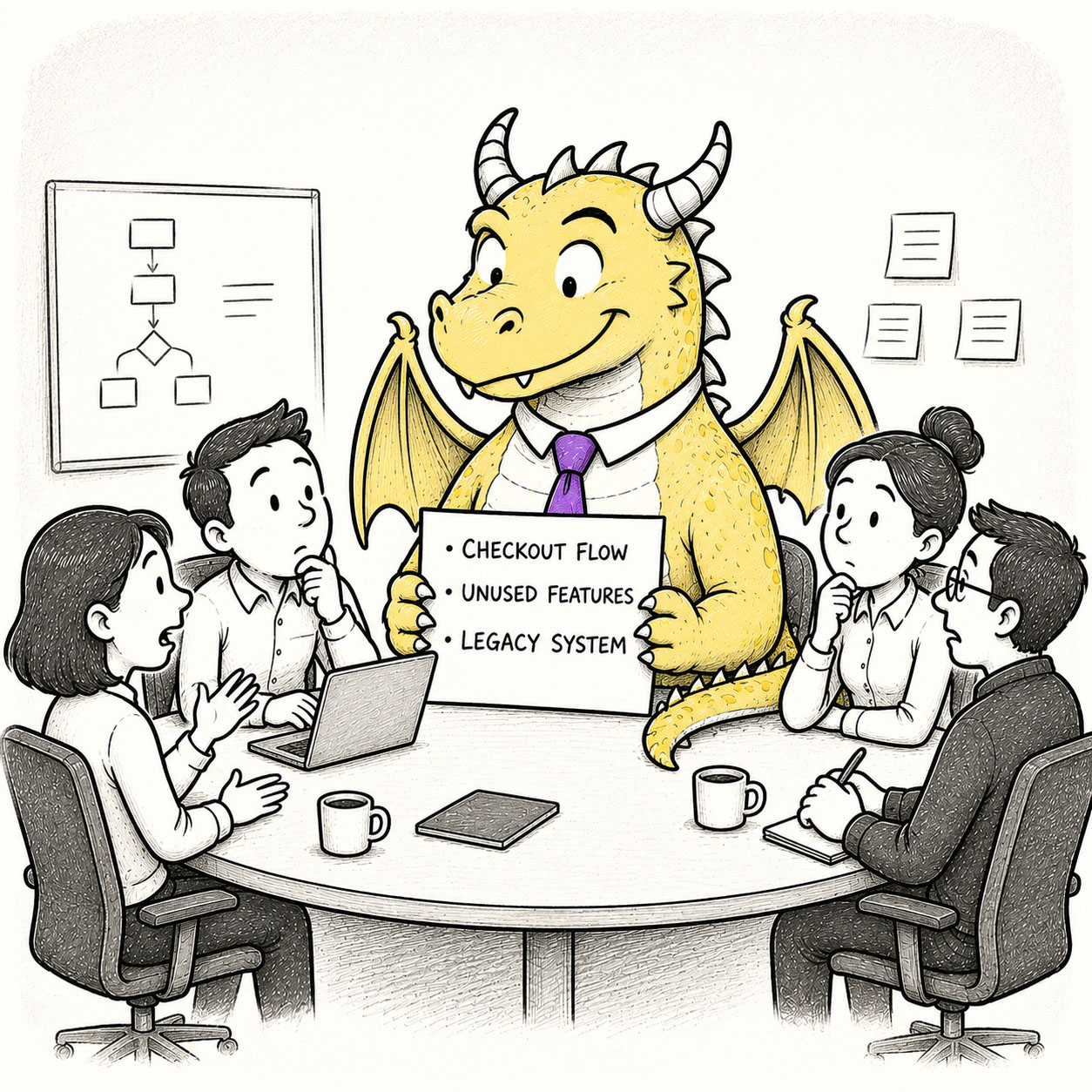
Here Be Dragons is a popular phrase to depict dangerous or unexplored territory. Everyone knows it’s there yet nobody quite understands it.
In product design, it refers to uncharted, complex, or risky areas of a product or system. So the team draws an imaginary border around that part of the product. Beyond that line lie unknown dependencies, mysterious design decisions, legacy code, forgotten business rules, or angry customers. The dragons may or may not be real. Nobody particularly wants to find out.
ORIGIN
The phrase Here be dragons is famously associated with old maps and the idea that medieval cartographers marked unknown or dangerous territories with dragons, sea monsters, and other fantastical creatures.
The reality is a little less dramatic. Historic maps certainly featured strange creatures in distant and poorly understood regions, but here be dragons was never a common cartographic warning. One of the few known examples appears on the Hunt-Lenox Globe, dating from around 1508, where the Latin inscription HC SVNT DRACONES – “Here are dragons” – appears near the eastern coast of Asia.
More commonly, cartographers used ideas such as terra incognita: unknown land. Where reliable knowledge ended, so did the map.
Over time, Here Be Dragons became a metaphor for exactly that boundary: the point where knowledge gives way to uncertainty, speculation, and potential danger. Software developers adopted the expression too, using it to warn others about obscure, complicated, or particularly hazardous areas of code.
WHEN
Product teams have their own maps – and plenty of places where someone has drawn a dragon. Places you may encounter Here Be Dragons include the following:
- Nobody knows why something works the way it does
“It’s always been like that” is the closest thing available to documentation.
- Certain parts of the product are carefully avoided
Everyone agrees the workflow is terrible. Changing it, however, is apparently forbidden by the HiPPO.
- Assumptions have quietly become facts
“Users need this” has been repeated for three years. Nobody remembers asking them.
- Knowledge has turned into folklore
Someone remembers that somebody once tried changing it and “something bad happened.”
- Success is assumed rather than demonstrated
The team shipped the redesign and moved on without finding out whether it actually improved anything.
- You hear: “We don’t touch that.”
No further explanation is considered necessary.
If a part of your product is governed more by assumptions, warnings, and stories than evidence, you’ve reached the part of the map marked Here Be Dragons.
WHY
Dragons thrive where knowledge disappears. Following are some of the reasons this may happen:
- Complexity accumulates
Features, exceptions, integrations, workarounds, and business rules pile up until nobody understands the entire system.
- Knowledge leaves
Designers change teams. Engineers leave. Product managers move on. What was once common knowledge becomes organizational archaeology.
- Decisions lose their context
Teams document what was built but not why. Years later, intentional constraints and historical accidents become indistinguishable.
- Team lacks understanding
It takes time and courage to explore the unknown.
- Unknown becomes synonymous with dangerous
When evidence is missing, imagination fills the gap – and imagination has excellent dragons.
HOW
Key to avoiding dragons is to turn unknowns into things that can be explored, tested, and measured. Follow these steps to map the uncharted:
- Acknowledge “we don’t know”
Recognize the unknown rather than pretending the territory isn’t there. - Map what you don’t know
Identify undocumented workflows, uncertain dependencies, unanswered research questions, and assumptions nobody has verified. - Test old assumptions
Technology changes. Business rules change. Users change. A constraint from five years ago may no longer exist. Show your dragons. - Separate dragons from drawings of dragons
“Changing this will break billing” is a claim that can be investigated. “We must not change that” is folklore. - Define what success looks like
Decide what outcome you expect and how you will recognize and measure it. - Explore incrementally
Use research, prototypes, technical spikes, experiments, feature flags, and small releases to learn without betting the entire kingdom.
- Document the expedition and update the map
Once territory is understood, replace the dragon. Don’t make the next team rediscover the continent.
The goal is to replace imaginary monsters with actual knowledge – but it requires determination and courage.
PRO TIP
As designers, we must measure our assumptions and make the outputs understandable to the business. Otherwise we are part of the folklore.
EXAMPLES
- A checkout flow nobody wants to redesign because its business rules aren’t documented.
- A legacy feature that research consistently identifies as confusing but the team considers too risky to change.
- An old component everyone continues copying because nobody knows why it was designed that way.
- A team insists users need a feature despite having no research or behavioral data supporting the assumption.
- A product area previously owned by someone who left years ago, taking most of its institutional knowledge with them.
- A designer asks why a strange field is mandatory and receives the historically significant answer: “Just don’t remove that.”
CONCLUSION
Every mature product has unexplored territory. Systems become complicated, people leave, decisions lose their context, assumptions escape from research decks and somehow become facts, and yesterday’s perfectly sensible workaround becomes today’s mysterious dropdown with seventeen options.
There’s nothing inherently wrong with having blank spaces on the map. Design always involves uncertainty. In fact, acknowledging those blank spaces is considerably healthier than pretending we already understand them.
The danger begins when “we don’t know” quietly turns into “we don’t go there.” That’s when assumptions become warnings, warnings become folklore, and teams stop asking whether the monsters drawn on their maps actually exist.
Good product teams don’t pretend there are no dragons, they show their dragons – the risks, assumptions, uncertainties, and unexplored territory – and then systematically go looking for evidence.