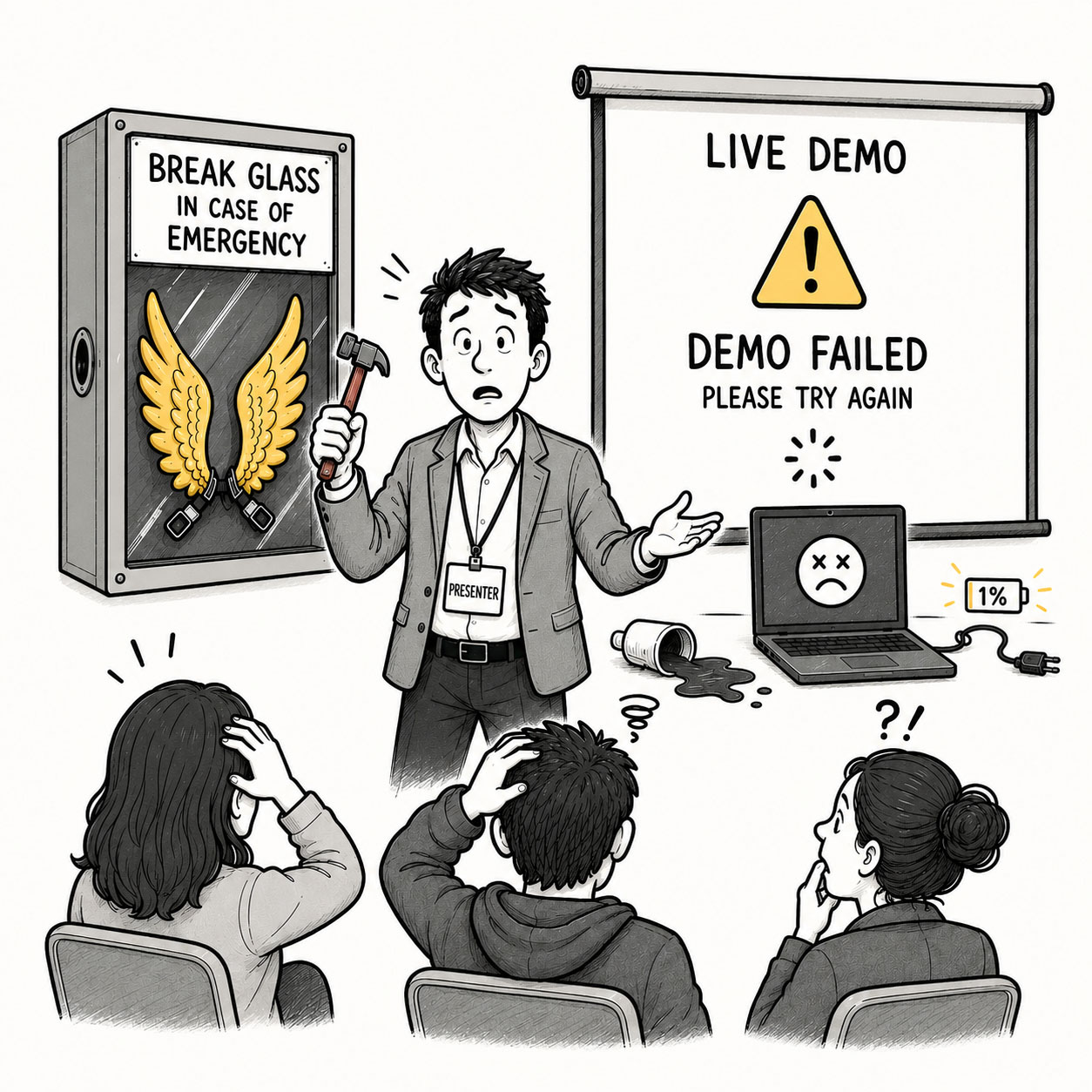
Winging It refers to improvising or operating without a formalized, structured plan, often creating design solutions or research approaches “on the fly”.
As a strategy, it is generally considered unprofessional and risky in a professional UX context, as you should always follow a defined, strategic process.
As a situation, winging it is almost inevitable. UX consultants cannot control all aspects of their work and winging it is therefore a key skill in their toolbox of techniques to turn awkward situations into research gold.
ORIGIN
Winging it is an expression from theater that dates back as far as the late 19th century. It refers to actors who would improvise without a script, often hurried into learning their lines while waiting in the wings of the stage from where they received additional prompts.
In 1933, Philip Godfrey explained in his book Back-stage: a survey of the contemporary English theatre from behind the stage: “He must give a performance by ‘winging it’ – that is, by refreshing his memory for each scene in the wings before he goes on to play it.”
WHEN
You’ve encountered classic Winging It moments when:
- A user interview goes completely off script
Your carefully prepared questions are still there. The conversation has other plans.
- The participant doesn’t match the expected persona
The person in front of you apparently didn’t read the research plan.
- The prototype breaks mid-session
The thing you were planning to test has decided it would prefer not to participate.
- Technology abandons you
Your laptop dies, the connection disappears, or the presentation refuses to present.
- The situation changes unexpectedly
A question, behavior, constraint, or circumstance appears that wasn’t part of the plan.
- You hear yourself say: “Oh crap, this isn’t going well.”
The official moment when preparation hands the controls to improvisation.
WHY
Winging It happens because reality doesn’t always follow the rules, it’s messy. Even the best plan can take a turn and shatter in a matter of seconds. Some of the reasons for that happening are the following:
- Users are unpredictable
They don’t behave like personas. Real people bring unexpected behaviors, questions, needs, and circumstances into even the most carefully planned session.
- Systems fail
Prototypes, environments, and tools can break – often at the worst possible time (see Murphy’s Law).
- Context shifts
What made sense during preparation doesn’t always fit the situation once you’re actually in it.
- Over-structured plans become fragile
Rigid scripts don’t adapt well when reality takes the conversation or session somewhere unexpected.
- Unexpected situations arise
Someone asks you a question that you have absolutely no clue how to answer.
Preparation is the basis for success but you cannot plan for all possible situations or eventualities. Sometimes you have to just have to fly by the seat of your pants (a phrase from aviators in WW2 who often had to fly in poor visibility with few instruments to help).
HOW
Winging It isn’t failure, it’s a key communication and facilitation skill, some may even say it’s art. It takes a lot of energy, brain power and creativity to do well. Following are some strategies to be better prepared when the moment arrives:
- Know the goal, not just the script
If you understand what you’re trying to learn, you can adapt how you get there when the original plan stops working.
- Be massively overprepared
While this sounds counter-intuitive, knowing the material well allows you to pivot with confidence instead of improvising blindly.
- Be open-minded
Nobody likes change (except casinos), but expect the unexpected and be mentally prepared to deal with it when it arrives.
- Be willing to let go of the plan
Recognize when it’s time to detach from the script. If the prototype breaks, talk through the concept instead – think outside the box rather than desperately trying to restore the original plan.
- Use the situation
An unprepared participant, broken flow, unexpected question, or unusual behavior can reveal something the planned session never would. You often learn the most in these moments.
PRO TIP
I can say with 100% certainty that there are more UX practitioners out there winging it than you realize. Don’t assume that everyone and everything is flawless, because they aren’t. Acknowledge when these situations arise – it shows that you (and the world) are human. Then refocus on your goal, adjust your plan, and navigate with confidence.
EXAMPLES
- A usability test where the prototype fails – but the conversation reveals deeper issues
- An interview that turns into storytelling instead of structured answers
- A participant who uses the product in an unexpected way – and teaches you something new
- A session where none of the prepared questions get asked – but all the right ones do
- A workshop that goes off track – and lands somewhere better
CONCLUSION
Winging It is an essential skill to possess. It shows that you can think outside the box, adapt to newly arising situations quickly, and be flexible and work well under pressure.
The best plans, scripts, and preparations can take a turn in a heartbeat and fail under the chaotic circumstances of the real world. It’s the ability to cope when things go awry that enables you to hold things together. Be open minded and use these situations to turn good learning into true insights.