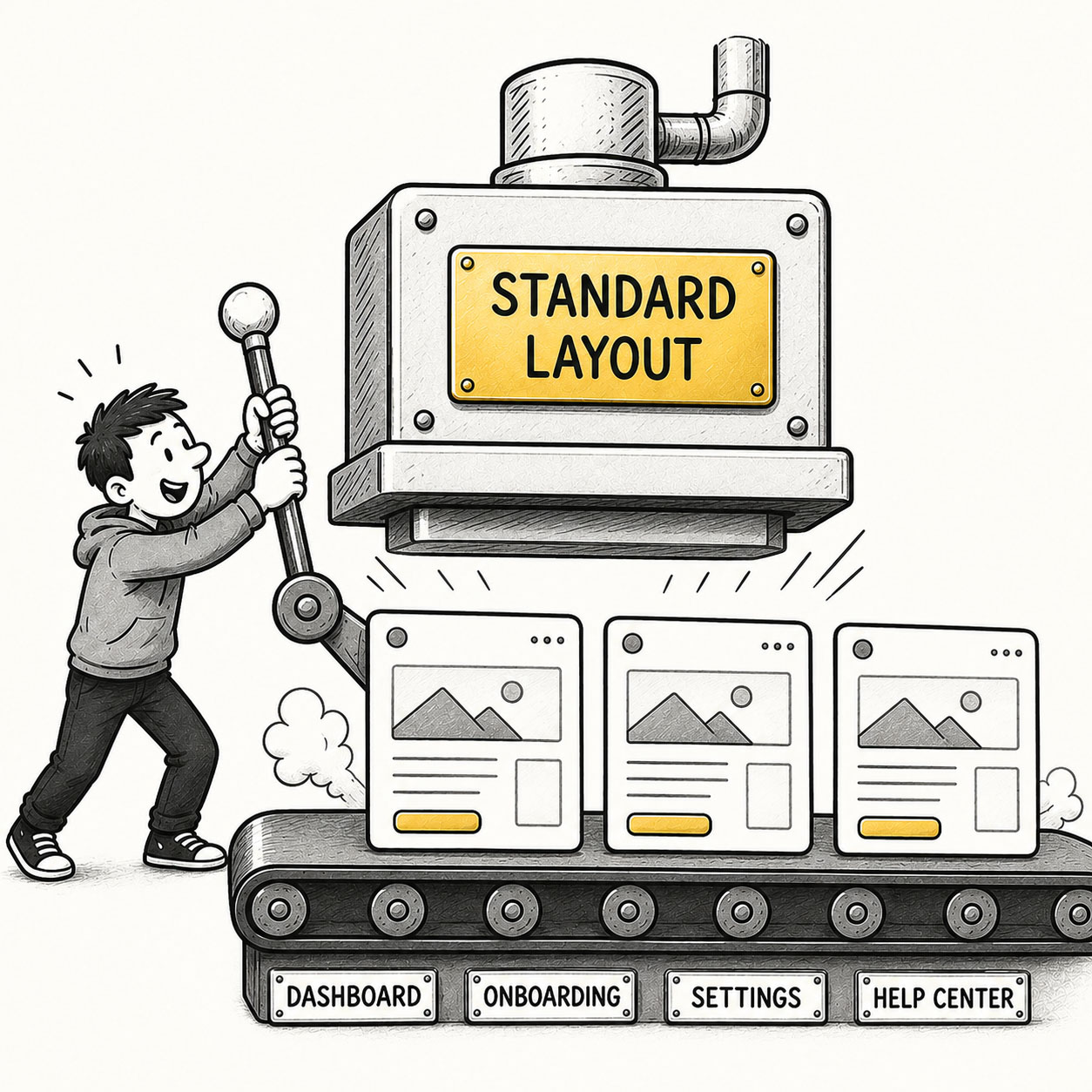
The term boilerplate refers to a standard, reusable piece of content used in various types of content, including articles, communication materials such as press releases, and contracts. It serves as a template for specific types of content, allowing consistency and efficiency in writing and communication.
In design, boilerplate elements include UI components, layout templates, or design systems to speed up the product development process. These pre-built kits aim to ensure consistency, reduce errors, and allow designers to focus on unique user needs rather than rebuilding basic elements.
ORIGIN
The word boilerplate originally had nothing to do with writing, software, or design. In the early 19th century, boiler plate referred quite literally to the heavy sheets of iron used to construct steam boilers. References to the material date to at least the 1830s.
During the late 19th and early 20th centuries, newspaper syndicates and organizations supplied smaller publications with prewritten material that could be printed with little or no local editing. Services such as the American Press Association, established in 1882, distributed ready-made news, features, advertisements, and other material to newspapers across the country.
The idea carried over into software and design – templates, components, and patterns meant to be reused again and again.
WHEN
Utilizing boilerplate content is often a good idea. It saves time and effort, but it runs risk of boring repetition and thoughtless experience. The following examples indicate situations when you may have encountered “bad” boilerplate:
- The same solution appears everywhere
Every page gets the same layout because every page started from the same template.
- A template survives regardless of context
The content clearly doesn’t fit, but the boxes are already there.
- Copy sounds strangely generic
“Your request has been successfully processed.” Whatever that means.
- Components are used because they exist
The design system contains a carousel. Exciting news for everything that apparently needs a carousel now.
- Teams stop questioning inherited decisions
Nobody knows why the pattern works this way. Everyone knows changing it would require a meeting.
- You hear: “Let’s just reuse what we had before.”
Sometimes excellent advice. Sometimes the beginning of a very efficient mistake.
- The solution appears before the problem is understood
Research hasn’t started, but fortunately someone already found the template.
WHY
Boilerplate thrives on convenience. The following situations describe why teams favor boilerplate:
- Speed beats reconsideration
Starting from something existing is faster than beginning with a blank page.
- Consistency feels inherently good
And usually it is. But consistency between two inappropriate solutions doesn’t make either one appropriate.
- Templates reduce cognitive effort
Decisions have already been made about structure, hierarchy, interaction, and presentation. That’s efficient – until those decisions don’t fit the current problem.
- Existing solutions feel validated
If something is already in the product, teams naturally assume someone previously determined it was correct.
- Design systems encourage reuse
As they should. But a component being available doesn’t mean it belongs in every situation where it technically fits.
HOW
The purpose of boilerplate is to reduce effort – never to replace intent. To use it well, apply these strategies:
- Understand the problem first
Don’t begin with “Which template should we use?”
- Treat boilerplate as a starting point
Reuse the parts that fit. Adapt the parts that don’t.
- Preserve intent alongside the pattern
Document when a component should be used, why it exists, and when another approach may be better.
- Adapt content to context
Generic structure doesn’t require generic language. Labels, instructions, errors, and actions should still make sense for the specific situation.
- Audit reused patterns periodically
Something appropriate three years ago may have survived mainly because everyone kept copying it.
- Make exceptions deliberately
Consistency matters, but consistency should support understanding rather than prevent better solutions.
PRO TIP
Question boilerplate and adapt – when in doubt, remove. Remember that any element added to a design WILL get implemented. Reuse the solution only after you’ve confirmed that you’re reusing the problem.
EXAMPLES
- Reusing a page layout even though the new content requires a different hierarchy.
- Copying a UX pattern between two workflows that look similar but serve different user needs.
- Using generic microcopy that technically works but doesn’t explain the specific situation.
- Adding every section included in a template because removing them feels like breaking the template.
- Starting a new project by copying the previous project and gradually discovering why the previous project was different.
CONCLUSION
Boilerplate is a tool. When used well, it creates speed and consistency. But used blindly, it creates friction and irrelevance. The goal therefore must be to use boilerplate with intent.
Good design comes from research, ideation, rapid prototyping, and consistency. Boilerplate can help building consistent prototypes quickly and identify poor design decisions quickly. Keep in mind that research and ideation is still on you, don’t press on without it.