Brainstorming is a collaborative, creative process designed to generate a wide range of ideas, enhance team collaboration, and solve complex problems. It typically involves a group of people that interact to suggest spontaneous ideas in response to a prompt.
In UX and product design, brainstorming appears everywhere – discovery workshops, Crazy 8s, sketching sessions, storyboarding, concept generation, and the occasional meeting that wasn’t supposed to be a brainstorm but somehow became one.
Done well, brainstorming expands the solution space and helps teams escape their first obvious idea. Done badly, eight people spend an hour watching the loudest person redesign the product.
ORIGIN
The modern concept of Brainstorming is closely associated with American advertising executive Alex F. Osborn. He was frustrated by conventional meetings in which ideas were criticized almost as quickly as they appeared. He believed judgment was interfering with imagination, so he experimented with structured group sessions designed specifically to generate ideas without immediately evaluating them. He described the approach as using the brain to “storm” a creative problem.
Osborn discussed brainstorming in his 1942 book How to Think Up and developed the method further in Applied Imagination in 1953. His approach emphasized four principles: generate lots of ideas, withhold criticism, encourage unusual ideas, and combine or improve ideas proposed by others.
The technique became enormously popular in business and eventually spread into design, education, innovation, and product development.
WHEN
Brainstorming sessions are mostly scheduled intentionally as part of discovery workshops or requirements gathering sessions. Sometimes you may stumble into impromptu brainstorming, which may or may not be productive.
You know you’re in a brainstorm when you encounter any of the following situations:
- A meeting is scheduled to “come up with ideas”
Nobody knows the answer yet. That’s why you’re all here.
- The blank whiteboard becomes the most important person in the room
For the next hour, its career prospects are excellent.
- Sticky notes appear
Usually in quantities suggesting the office-supply budget has already committed to innovation.
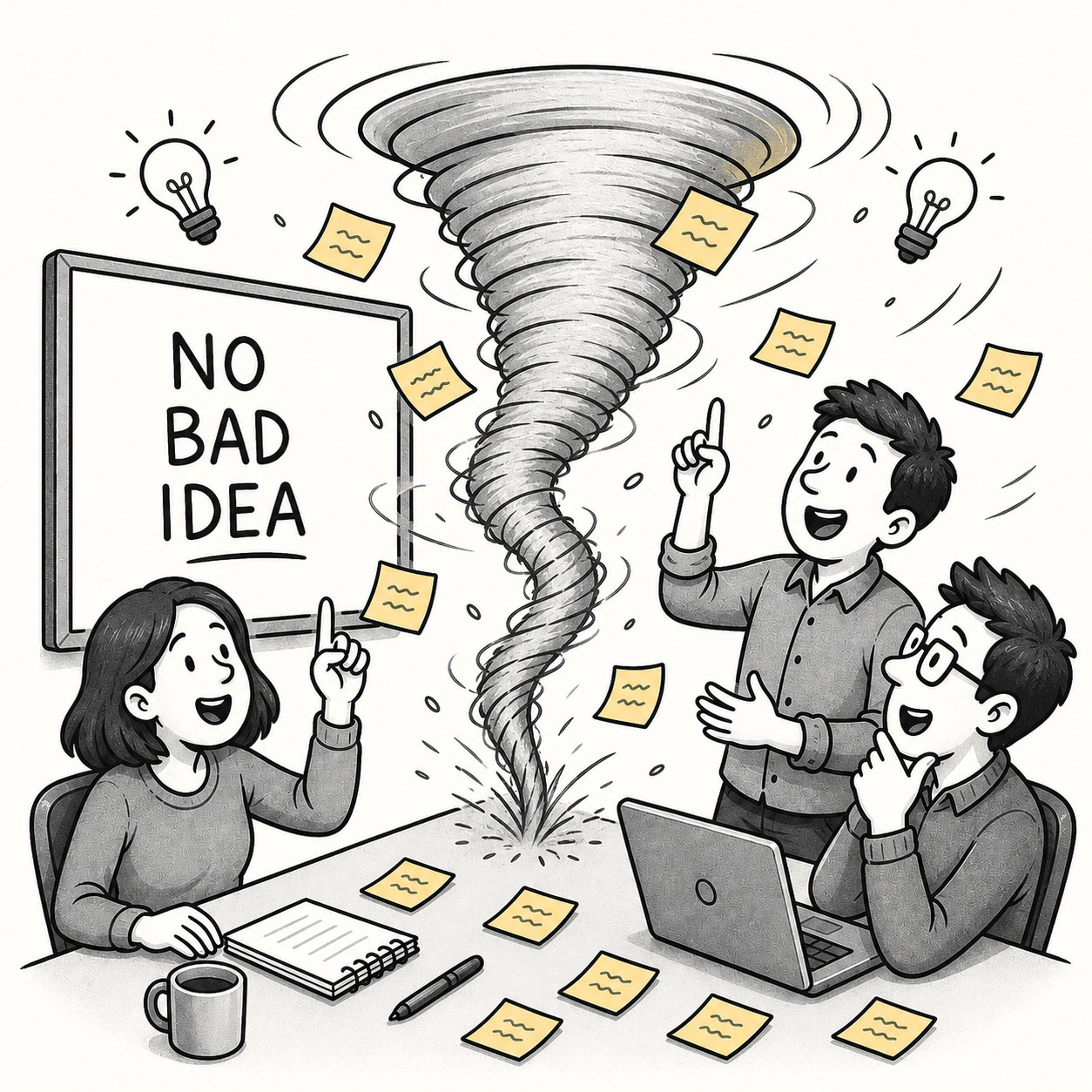
- Someone announces: “There are no bad ideas.”
Several participants immediately accept the challenge.
- Energy is high but direction is questionable
There are now 74 ideas. Nobody remembers the original problem.
WHY
Brainstorming feels productive because it looks like creativity in motion. If led and controlled well, brainstorming activities augments the creative process and produce valuable outcomes.
But various studies have found that the group dynamics change how people think and inadvertently may lead to producing fewer ideas than individuals working separately. The following factors can contribute to a loss of effectiveness in group brainstorming:
- Production blocking slows thinking
Only one person can speak at a time. Everyone else waits, forgets their idea, or starts thinking about what was just said instead.
- Evaluation apprehension creates silence
People may withhold unfinished, unusual, or risky ideas because colleagues are watching.
- Anchoring narrows the solution space
The first plausible idea can quietly become the center of gravity for everything that follows.
- Social conformity makes ideas safer
Once the room starts moving in one direction, proposing something completely different becomes harder.
- Participation becomes unequal
Confident or senior participants can unintentionally dominate while quieter people contribute less.
- Activity gets mistaken for progress
A wall covered in sticky notes looks impressively productive even when nobody has generated anything particularly useful.
The result is often fewer ideas, safer ideas, and more similar ideas.
HOW
Osborn said that two principles contribute to “ideative efficacy”: defer judgment and reach for quantity.
Brainstorming works best when it isn’t purely group-based. The most effective sessions separate thinking from sharing, and include an element of individual ideation. Follow these steps:
- Define the problem clearly
Give people a focused challenge. “How might we reduce abandonment during onboarding?” is more useful than “Let’s brainstorm the app.”
- Start individually
Give everyone quiet time to sketch or write ideas before group discussion begins. This prevents the first speaker from defining everyone else’s thinking.
- Go for quantity first
Don’t spend ten minutes defending idea number three. Generate twenty more.
- Defer judgment
Separate divergence from evaluation. An idea doesn’t need to survive forever; it just needs to survive long enough to inspire another one.
- Encourage unusual ideas
Wild ideas may never ship, but they can expose assumptions and create more practical alternatives.
- Build on other ideas
Combine, adapt, invert, simplify, exaggerate, or borrow parts rather than treating every suggestion as someone’s intellectual property.
- Use brainwriting and visual techniques
Silent writing, Crazy 8s, sketching, and similar methods give everyone a channel to contribute simultaneously.
- Allow thinking time
Silence isn’t evidence that the brainstorm has failed. Sometimes people are doing the activity you invited them to do: thinking.
- Use constraints intentionally
Constraints can focus creativity. Try “What could we solve without adding another screen?” or “What if users had only ten seconds?”
- Facilitate the room
Protect quieter voices, prevent premature critique, watch dominant participants, maintain focus, and capture ideas without turning every one into a debate.
PRO TIP
Don’t underestimate the social inhibitions among group members. Members of a group tend to perceive their productivity based on observation of the other team members. This often leads to a decrease (or increase) in quality and quantity of ideas. Identify extroverts that typically outperform introverts and match them up to receive a higher rate of productivity.
EXAMPLES
- A group session produces obvious ideas – while better ones stay unspoken
- The loudest voice sets the direction early
- Sticky notes fill the wall – but few are actionable
- A workshop feels successful, but leads to no decisions
- A quiet participant has the best idea – after the meeting
CONCLUSION
Brainstorming isn’t creative magic activated by putting people in a room. It’s a structured way of separating exploration from judgment so teams can generate possibilities before committing to solutions.
The best sessions create room for individual thinking, encourage quantity, delay criticism, invite unusual ideas, prevent dominant voices from setting the direction too early, and then deliberately move from divergence toward decisions.