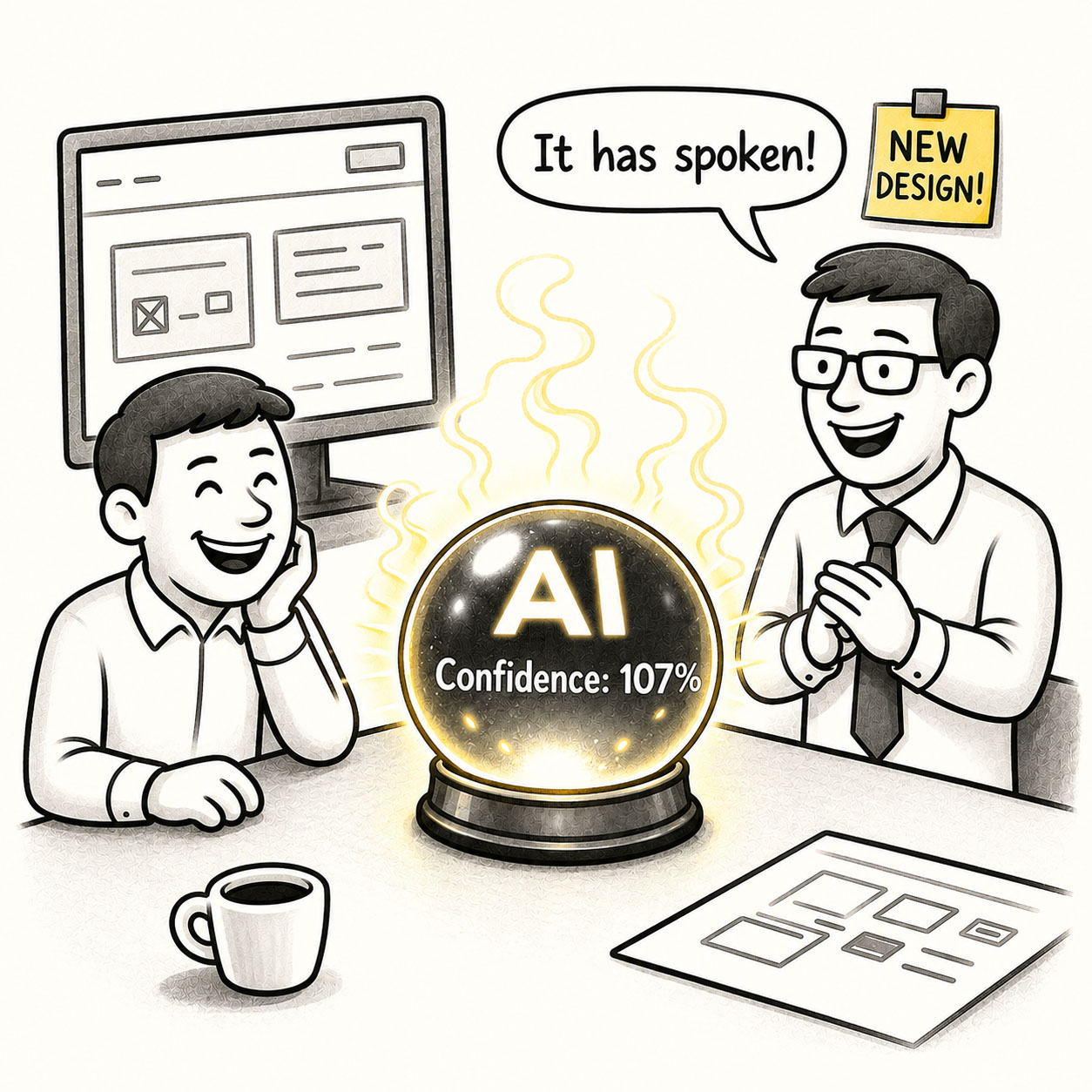
The AI Oracle Effect occurs when teams treat AI-generated output as inherently correct, authoritative, or strategically sound. AI stops being a tool and starts being treated like prophecy.
Instead of questioning, validating, or contextualizing the output, the team begins deferring to it. Research becomes a prompt. Recommendations become decisions. The system becomes the oracle. And the room gets surprisingly quiet.
ORIGIN
An “oracle” was a person or place believed to provide divine, all-knowing guidance or prophecy. The most famous was the Oracle of Delphi, one of the most important religious institutions of ancient Greece operating from the Temple of Apollo on Mount Parnassus from around 1400 BC to the 4th century AD. The Oracle was a woman (the Pythia) who sat on a tripod over a fissure in the earth, breathing in fumes to enter a trance and deliver divine prophecies. Pilgrims traveled far to seek guidance. They offered sacrifices and paid fees to consult her.
The prophecies were famously ambiguous, requiring interpretation by priests and often leading to unexpected outcomes. One of the best-known ancient stories tells of King Croesus, who was supposedly told that if he attacked Persia, he would destroy a great empire. He did. Unfortunately, it was his own.
In modern product teams, AI systems have quietly inherited that role. Not because they are divine, but because they are fast, articulate, and statistically convincing.
WHEN
You’ve encountered the AI Oracle Effect when you run into any of the following situations:
- “Let’s ask AI” replaces investigation
A useful starting point quietly becomes the entire research plan.
- AI-generated summaries replace the source material
Nobody has read the original research, but everyone has read the seven-bullet summary.
- Synthetic users replace actual users
Personas, needs, behaviors, and opinions are generated from prompts rather than learned from real people.
- Recommendations arrive without validation
The output sounds reasonable, so nobody checks whether it’s actually supported by evidence.
- AI settles disagreements
Instead of discussing competing assumptions, someone asks the model and treats its response as the deciding vote.
- Confidence gets mistaken for correctness
The answer contains no hesitation, therefore neither does the team.
WHY
The AI Oracle Effect sits at the intersection of automation bias, authority, convenience, and our perfectly understandable desire for answers.
- Fluency looks like expertise
AI can present uncertain, incomplete, or incorrect information in polished and authoritative language.
- Speed feels powerful
Research might take weeks. The model answers in seconds. Under pressure, the difference is extremely seductive.
- Feeling of sophistication
A recommendation can feel less subjective when it comes from a system rather than another person in the meeting.
- Nobody wants to argue with the machine
When no one in the room fully understands how an answer was produced, challenging it can feel harder than challenging another person’s opinion.
AI doesn’t need to be infallible to become an oracle. People only need to start treating it as though it is.
HOW
The AI Oracle Effect manifests subtly. Over time, teams stop debating and start deferring instead. AI becomes less of a collaborator, and more of a silent decision maker.
The answer isn’t to distrust AI. It’s to preserve human judgment around it.
- Treat outputs as hypotheses
An AI recommendation should give you something to investigate, not something to obey.
- Ask for evidence
Trace important claims back to reliable sources, research, data, or direct observation rather than relying on the confidence of the response.
- Keep humans in the loop
AI can help analyze interviews, organize findings, and generate questions. It cannot magically manufacture the lived experience of users you never talked to.
- Challenge convenient answers
When AI produces exactly the recommendation everyone hoped for, that’s an especially good moment to test it. - Context matters
Models often lack critical information and intuition that only humans can grasp.
- Make responsibility explicit
The model can recommend. Humans still decide – and remain accountable for the consequences.
AI can be an extraordinarily useful collaborator. Just don’t give it a tripod and build a temple around it.
PRO TIP
Treat AI output as a starting point, not a verdict. The model can generate the answer; the responsibility for believing it remains yours.
EXAMPLES
- A product team adopts AI-generated feature priorities without validating customer demand.
- A dashboard identifies “high opportunity regions” using an AI model nobody has checked against the underlying data quality.
- Personas are generated entirely from prompts and subsequently cited as evidence of user needs.
- A strategy deck contains AI-generated market recommendations without anyone verifying the sources behind them.
- A stakeholder ends a design debate with: “AI told me so.”
CONCLUSION
AI is extraordinarily useful precisely because it can accelerate thinking, synthesize information, surface patterns, explore alternatives, and help teams reason through complicated problems. None of that requires pretending it’s infallible.
The danger begins when convenience becomes authority. When “the model said so” becomes sufficient justification for a decision, AI has moved from collaborator to oracle.
Design still requires judgment. Strategy still requires context. Ethics still require humans. Good teams ask AI questions. Great teams also question the answers.
The moment AI becomes unquestionable is the moment it stops being useful. That’s when AI starts becoming an oracle.
Related patterns: Metrics Mirage • Confirmation Bias • Executive Seagull Effect • Dark Forest UX • Automation Complacency