The Hawthorne Effect is a type of behavioral reactivity in which individuals change their behavior simply because they know they are being observed.
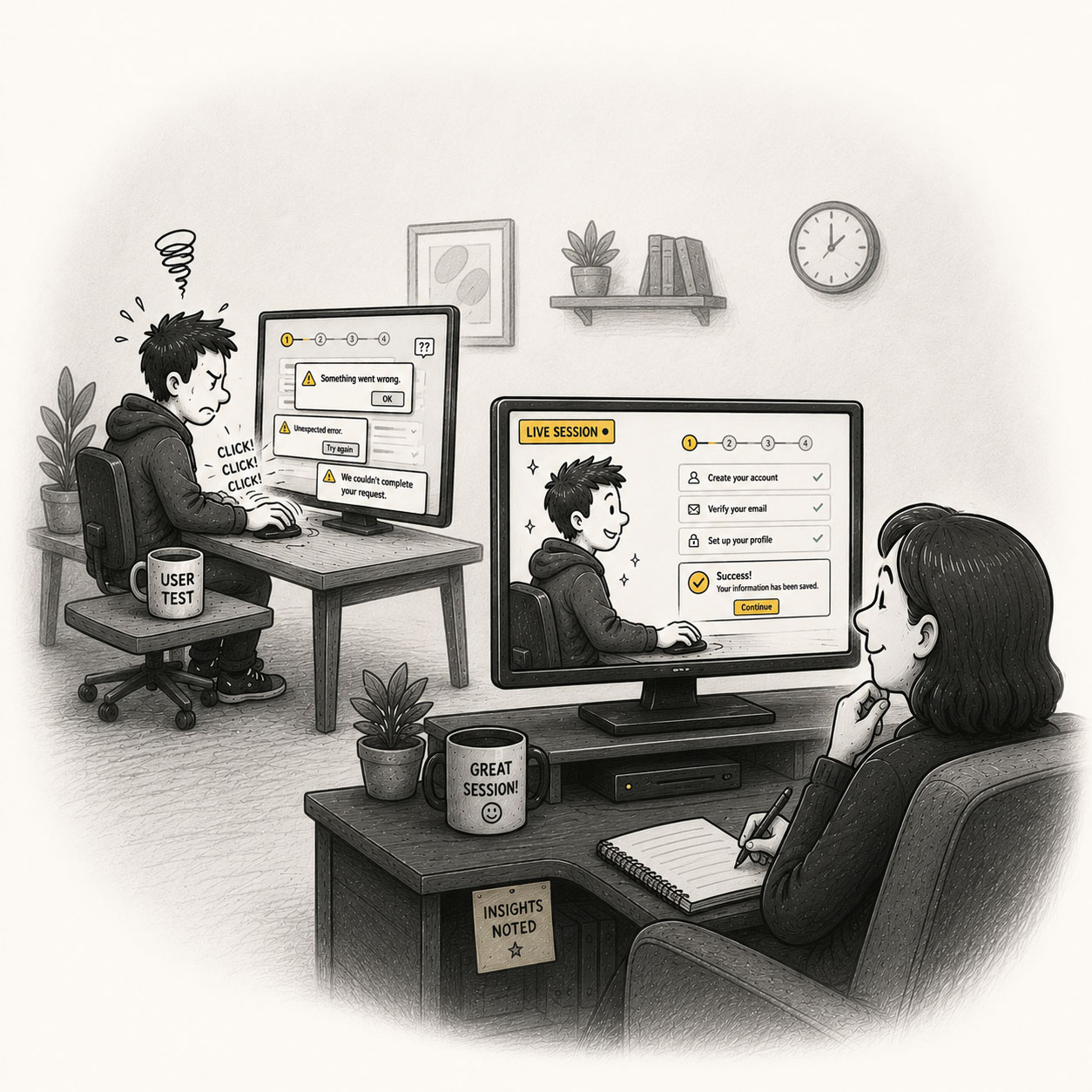
In UX research, this creates a subtle but powerful distortion: the moment a session begins, the behavior you are trying to study is no longer entirely natural. Participants become more attentive, more deliberate, and often more careful than they would be in their everyday interactions. As a result, what looks like a smooth and successful experience in testing can quietly mask the friction and confusion that exist in the real world.
ORIGIN
The Hawthorne Effect traces back to a series of studies conducted in the 1920s and 1930s at the Hawthorne Works factory near Chicago. Researchers set out to understand how changes in working conditions – such as lighting, breaks, and schedules – affected worker productivity. Surprisingly, productivity improved regardless of whether conditions were made better or worse. Even when changes were reversed, performance continued to increase.
Over time, researchers realized that the improvements were not caused by the experimental conditions themselves, but by the workers’ awareness of being observed. The attention, rather than the intervention, influenced behavior. This insight became known as the Hawthorne Effect and has since been widely applied across psychology, research, and user experience design, where observation itself can unintentionally shape outcomes.
WHEN
You’ve encountered the Hawthorne Effect when:
- Users behave more carefully than usual
They read more. They hesitate less. They try harder to succeed.
- Tasks are completed more successfully than in real life
The flow works perfectly… for the test participant.
- Participants try to “do the right thing”
They aim to please the facilitator instead of acting naturally.
- Behavior feels slightly too ideal
Everything looks smoother than expected.
- You hear: “I would normally…”
Followed by behavior that contradicts it.
If users perform better in the test than in reality, you’re seeing it.
WHY
The Hawthorne Effect is driven by awareness and may be due to the following situations:
- Observation changes behavior
People act differently when they know they’re being watched.
- Desire to perform well
Participants want to be helpful, competent, and “good test subjects.”
- Social pressure
Even subtle cues from the facilitator influence behavior.
- Artificial context
Testing environments are not real environments.
As a result, whether you like it or not, you don’t just test the product. You test the performance of the participants.
HOW
Explore the following strategies to reduce or eliminate the Hawthorne Effect:
- Make the environment feel natural
The more realistic the setup, the more authentic the behavior.
- Be neutral as a facilitator
Avoid guiding, reacting, or signaling approval.
- Use realistic tasks and context
Abstract scenarios increase artificial behavior.
- Combine methods
Pair moderated sessions with analytics, field studies, or unmoderated tests.
- Look for patterns, not perfection
Individual success doesn’t always reflect real-world usage.
PRO TIP
Good research doesn’t assume that user behavior is pure, it accounts for distortion and variation from reality. Stay alert and remember that if users perform perfectly, something is probably off.
EXAMPLES
- A usability test where users complete tasks flawlessly but real users struggle
- Participants carefully reading every label they would normally skim over
- A user slowing down and overthinking simple actions
- Feedback that sounds “correct” but not authentic
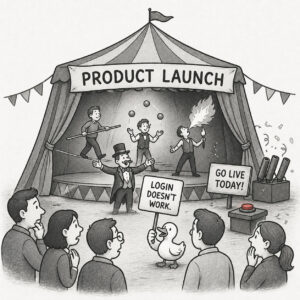
- A product that tests well but performs poorly after launch
CONCLUSION
The Hawthorne Effect is a reminder that observation changes reality. The moment you watch users, you influence them to adjust their behavior.
Good UX research doesn’t try to eliminate this effect, it acknowledges its existence and adjusts observational insights. Create tests that are meaningful, real-world, and feel as natural as possible. Disrupt perfect behavior as often as possible.