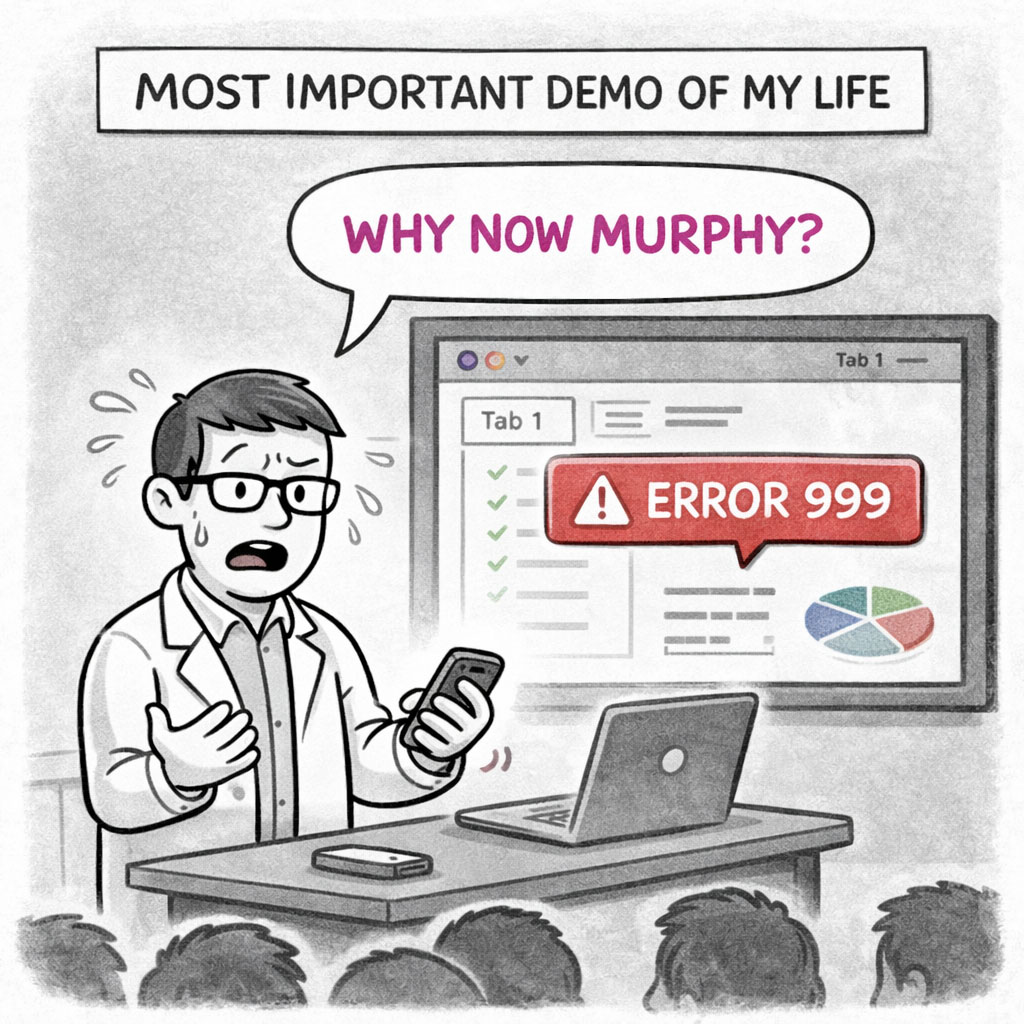
Murphy’s law is an epigram that is typically stated as: “Anything that can go wrong will go wrong.”
In UX and product design, Murphy’s Law captures the grim inevitability that if there’s a way for something to fail – no matter how unlikely – it eventually will.
A feature will break at the worst possible moment. A user will try the one interaction no one tested. A stakeholder’s favorite edge case turns out to be a real-world requirement. Murphy’s Law isn’t pessimism – it’s about preparation.
ORIGIN
While the concept itself had been known for a long time, the phrase “Murphy’s Law” is attributed to Capt. Edward A. Murphy Jr., an engineer working on U.S. Air Force projects in the late 1940s. On tests where sensors were installed incorrectly, Murphy reportedly remarked about the technician:
“If there’s a way to do it wrong, he’ll find it.”
From there, the saying evolved into a broader principle: Anything that can go wrong, will go wrong – often at the worst possible time. Over decades, Murphy’s Law spread from engineering into business, risk analysis, and eventually UX/product design.
In design, Murphy’s Law reminds us that no matter how confident we are in a flow, users will test its limits – and technology will surprise us.
WHEN
You’ll feel Murphy’s Law in UX when:
- Edge cases surface after launch
- A rare combination of settings breaks a feature
- An overly motivated user encounters an untested interaction
- A new release causes regressions in unrelated parts of the product
- A stakeholder’s “small tweak” causes disproportionate trouble
If you’ve ever said, “We tested everything…” only to watch something fail spectacularly in production – you’ve met Murphy’s Law.
WHY
Murphy’s Law isn’t mystical – it’s a natural consequence of complexity.
Systems are not linear. A rare input, device, or sequence can trigger errors no one anticipated. Even the best designers and testers can’t pre-experience every possible scenario. Consider the following types of variables:
- Assumptions: what we think users will do
- Dependencies: code, devices, networks, platforms
- Combinations: interactions multiplied across features, data, and users
When you combine enough of these variables, surprising states may – or what Murphy’s Law states – will emerge because the space of untested combinations is always larger than the space of tested ones.
HOW
Murphy’s Law shows up in product development in the following situations:
- Unexpected edge cases: A rare device configuration, locale, accessibility setting, or data state exposes a flaw.
- Feature interactions: Two features that work well independently may conflict when combined.
- Timing effects: Network latency, race conditions, caches, and asynchronous updates cause unpredictable behavior.
- Human unpredictability: Users click, tap, and swipe in ways designers never imagined.
- Perfect storms: A bug that only appears in production when certain variables align.
Murphy’s Law doesn’t predict design flaws per se, it’s more an invitation to be more resilient and observant by applying the following strategies:
- Expect the unexpected: don’t assume ideal inputs or paths
- Handle failure gracefully: show helpful, clear recovery UX
- Use defensive design: validate inputs, guardrails, defaults
- Test broadly: include uncommon locales, devices, states
- Observe real users: watch how people actually use the product
- Monitor and iterate: logs, metrics, and feedback catch what tests miss
PRO TIP
Murphy’s Law doesn’t mean you should design for doom, it means planning for resilience. Good design doesn’t eliminate failure, it makes failure survivable.
EXAMPLES
Place where you can observe Murphy’s Law in action include the following:
- A form only fails when a VIP tries to submit with an uncommon character in their name
- A filter that works until two specific fields are selected together
- A push notification that crashes on a rare OS version
- A dashboard that loads fine until the user’s data grows beyond a threshold
What all these scenarios have in common is that the possibility of failure is eminent, and it was only a matter of time for them to occur.
CONCLUSION
Murphy’s Law isn’t a curse – it’s a reality-check that leads to more resilient design. It reminds UX designers and product teams that the universe does not reward optimism about edge cases and that any design decision must be taken with foresight.
At the end of the day, you can’t predict every failure, but you can design systems that detect problems quickly, recover gracefully, and learn from them continuously.


